

This article is a six-month review of signals showing the direction and timing of AI-related shifts in employment in the United States. It has deep implications for workers, companies, investors, and leaders across the rapidly changing business world. Here’s what I want you to know:
AI-driven job elimination is accelerating now
The trend is toward spreading job loss
New jobs aren’t being created—yet
Regret rehires fuel a fantasy that this trend might reverse
Companies are sowing the seeds of a sharp backlash
If you’re looking for work now, the wait will likely be a long one
Labor elasticity and portfolio careers are the dominant themes of what’s next
Grim, right? But I’m staunchly optimistic. This reset will be the best thing to happen to people and to business in the history of business. Maybe of history itself. This article aims to tell you what’s happening, what’s likely to happen in the months ahead, and when we’re likely to see those changes. It’s going to be a tough adjustment with some real pain in the journey.
There’s the way things are now, the way we imagine they could be, and the path to getting there. This is about that path.
Signals over predictions
Two men sit in a living room in a small town in Tennessee on a cold, overcast Sunday. They’re both approaching 80 years old, and both of them have been leaders in the community for decades. In a town of vacant factories and boarded up businesses, they’re talking about Amazon laying off 16,000 people.
Both of them are deeply concerned about what AI means for jobs.
I know the feeling. Six months ago, I published a piece arguing that leading indicators of AI-driven workforce displacement were screaming—that we had roughly eighteen months before systemic disruption began, concentrated between Q1 2026 and Q3 2026.
At the time, most people thought it would take 3-4 years before we saw disruption.
Something about that felt off to me. I had a hunch that the changes in the job market would happen a lot sooner. I went down a rabbit hole, poking at the numbers and looking for signals that could help me understand how this might unfold. I began locking onto leading indicators rather than lagging ones like unemployment rate. I worked through chains of capital investments, infrastructure buildout, and corporate strategy to create a model that found coherence in a broad diversity of signals and signal types.
I hit “send” on The Last Normal Year in August 2025.
The article didn’t pretend to be a prediction engine. Predictions are theater. It was a signal detection system built on the same methodology that would have flagged cloud computing’s impact on IT employment in 2013 or mobile banking’s effect on teller jobs in 2012. Capital expenditure patterns, hiring velocity changes, executive messaging shifts, infrastructure bottlenecks—measured at each layer of the causal chain between investment and unemployment.
We’re now at the six-month mark. The lagging indicators are starting to move. And I owe you an honest accounting of what the instruments got right, where they were off, and what emerged that I hadn’t contemplated at all.
What the model got right
The core thesis — that we were sitting at a procurement inflection point in August 2025, and that systematic displacement would begin materializing by Q1 2026—has held up against six months of data better than I expected.
The causal chain is firing in sequence. The framework tracked a specific progression: capital investment → infrastructure deployment → executive strategy → hiring demand changes → payroll changes → unemployment outcomes. Every layer has now activated.
Capital investment didn’t just continue—it accelerated beyond what I modeled. Hyperscaler AI CapEx went from $256 billion in 2024 to $443 billion in 2025 to a projected $602 billion in 2026. That’s not the linear curve most analysts were projecting. Microsoft alone spent $72.4 billion in the first months of fiscal 2026. Amazon is projecting $200 billion for the full year. When I wrote about the procurement inflection point, these numbers hadn’t been reported yet—but the directional signal was already visible in the infrastructure buildout.
Hiring demand has collapsed across multiple measurement systems simultaneously. Indeed’s job postings index fell to levels last seen in 2017—effectively erasing a decade of growth. LinkedIn’s hiring rate is running 20% to 35% below pre-pandemic levels. LinkUp shows active postings declining 12.3% year-over-year, with new postings dropping even faster at 12.6% month-over-month. JOLTS openings hit 6.54 million in December—the lowest reading since September 2020 (deep into COVID), with a single-month decline of 386,000.
The breadth matters more than any individual data point. When Indeed, LinkedIn, LinkUp, Revelio, and JOLTS all deteriorate simultaneously across different methodologies, there’s not a lot of noise. You’re looking at signal.
Payroll data confirmed hiring demand signals—and got revised to look worse. ADP’s January 2026 report showed net additions of just 22,000—the weakest reading since early 2024. Professional and business services shed 57,000 jobs in a single month. For all of 2025, ADP recorded 398,000 net new jobs, down from 771,000 in 2024—a 48% decline. BLS nonfarm payrolls initially reported 584,000 total jobs added in 2025. That number was subsequently revised down to just 181,000—roughly 400,000 fewer jobs than initially reported, and a fraction of the 1.4 million added in 2024. January 2026 came in at 130,000, with unemployment ticking down to 4.3%. The revision is telling: the labor market was weaker throughout 2025 than anyone realized in real time. The leading indicators were right, and the lagging data was initially understating the deterioration.
The executive narrative shifted from investment language to headcount language. This is the transition I flagged as a leading indicator—when corporate leaders stop talking about AI as a capability investment and start talking about it as a workforce optimization tool. In Q3 2025, 306 S&P 500 companies mentioned AI on earnings calls, the highest count in a decade. But the words matter more than the count. Mentions of “agentic AI,” “AI workforce,” “digital labor,” and “AI agents” surged by multiples over the prior year. The language moved from “we’re investing in AI” to “we’re replacing headcount with AI.”
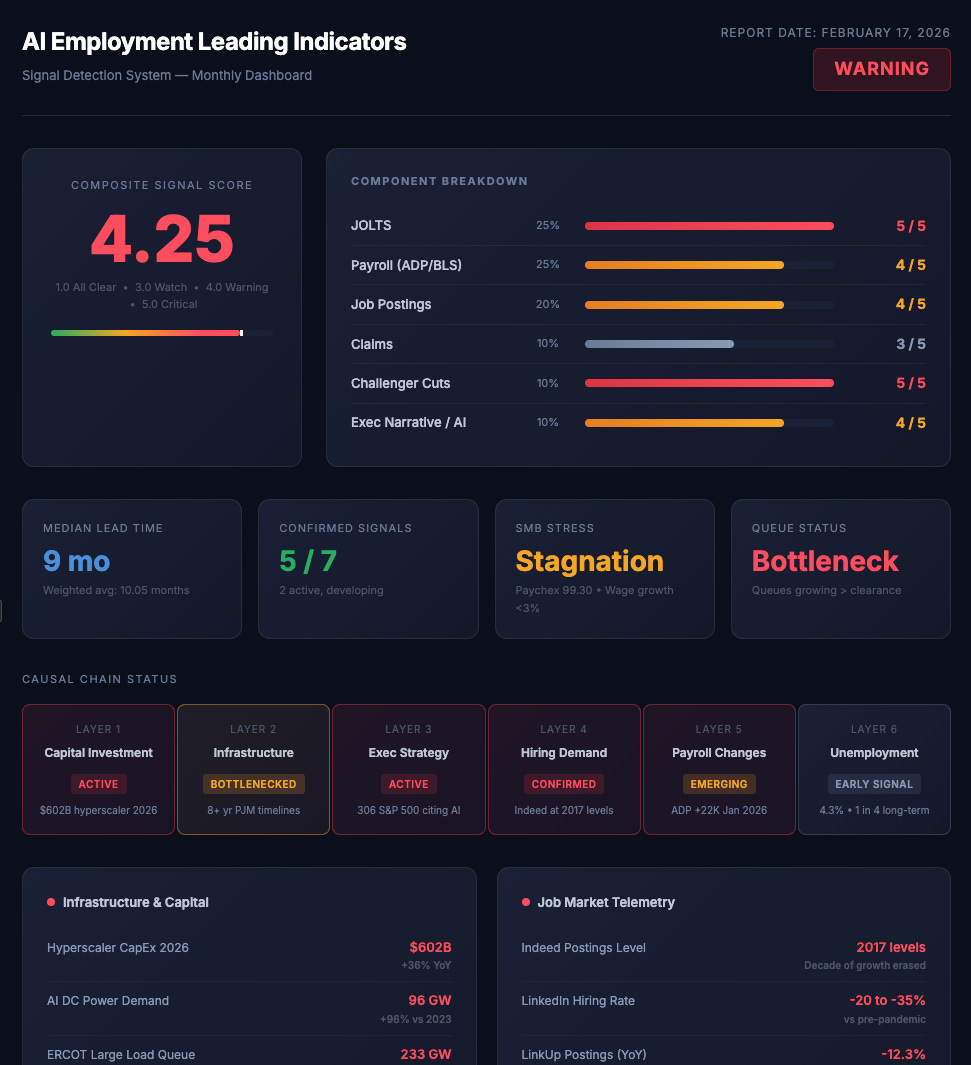
The lead time calculation validated the framework’s core purpose. The median lead time between when our indicators triggered and when lagging employment data confirmed the signal was 9 months, with a weighted average of 10.05 months. Five of seven tracked series have now been confirmed by lagging data. That’s the point of a leading indicator system—detecting structural shifts before official statistics move.
What the model got wrong
Intellectual honesty requires accounting for where the framework missed or mischaracterized what actually happened.
The wave structure was too clean. I described three discrete waves: Wave 1 (Q1 2026, administrative and routine cognitive), Wave 2 (Q2-Q3 2026, creative and analytical), Wave 3 (Q4 2026+, managerial and strategic). The data shows something messier. Displacement isn’t arriving as sequential waves—it’s manifesting as a continuous tightening across multiple vectors simultaneously.
January 2026 Challenger data showed 108,435 planned cuts—a 17-year high for January, up 118% year-over-year. But these cuts span administrative, technical, and creative roles at the same time. Amazon announced 30,000 cuts across functions. Accenture eliminated 11,419 positions and publicly stated they would “exit” employees who can’t reskill on AI. Pinterest cut 15% of staff to redirect resources toward AI teams. Salesforce reduced customer support headcount from 9,000 to 5,000 as AI agents took over 50% of customer interactions. McKinsey claims to have 65,000 consultants, but 25,000 of those are AI agents.
The waves are overlapping, not sequential. Companies aren’t waiting for Wave 1 to finish before starting Wave 2. They’re restructuring holistically based on where AI capability meets organizational willingness.
The mechanism of displacement is quieter than I described. I framed the transition as organizations “beginning workforce optimization” — implying visible restructuring events. What’s actually happening is subtler and in many ways harder to track. Positions are being left unfilled when people leave. Hiring intent has collapsed: Challenger reported only 5,306 new hire announcements in January 2026, the lowest January figure since 2009. Entry-level job postings have declined 35% since January 2023 according to Revelio Labs, with tech entry-level positions down more than 50% over three years at major companies.
The displacement is happening through attrition and hiring freezes more than through layoff announcements. The Challenger cuts are real and significant, but they’re the visible portion of a larger structural shift that’s primarily manifesting as doors quietly closing.
I underestimated the speed of the capital deployment. When I wrote about $175 billion hyperscaler CapEx in 2025, the actual number came in at $443 billion. The 2026 projections—$602 billion aggregate—represent a scale of capital allocation I hadn’t modeled. Alphabet alone guided $175-185 billion for 2026, doubling its 2025 spend. This acceleration compressed the timeline between infrastructure buildout and deployment faster than the historical analogies suggested.
What I didn’t see coming
These are the signals and dynamics that emerged over the past six months that weren’t in my original framework.
Companies are laying off based on AI’s potential, not its performance. This is perhaps the most important finding I missed. Harvard Business Review published a piece in January 2026 documenting that companies are cutting headcount based on anticipated AI capability rather than proven deployment results. A Forrester survey from December 2025 found that 55% of employers report regretting AI-driven layoffs—many cut workers for AI capabilities that don’t yet exist as promised.
Klarna is the clearest example. CEO Sebastian Siemiatkowski publicly stated that AI helped the company shrink its workforce by 40%—from 5,527 employees to 3,422. Then he publicly admitted the aggressive transition degraded service and product quality, and the company began rehiring human staff. This regret cycle wasn’t in my model. I assumed rational deployment following proven capability. The reality is that corporate FOMO is driving preemptive cuts that may partially reverse—creating a more volatile displacement pattern than the smooth exponential I described.
This matters for the framework because it means some portion of the displacement signal is anticipatory rather than structural. The net effect is still displacement—but the path is messier, with potential rehiring cycles embedded within the larger trend. I don’t think this was about being wrong. I think it was just too soon. They got greedy.
The entry-level destruction is more severe and more measurable than I anticipated. Stanford’s Digital Economy Lab published what researchers called “the largest scale, most real-time effort” to quantify AI’s employment impact, using ADP payroll records covering millions of workers. The key finding: workers aged 22-25 in high-AI-exposure jobs—customer service, accounting, software development—experienced a 13% employment decline since late 2022. Workers aged 30+ in those same fields grew 6-12% over the same period.
That’s not generalized labor market softening. That’s a structural bifurcation where experience provides a protective moat and entry-level workers absorb the displacement disproportionately. College graduate unemployment reached 5.7% in Q4 2025, up from 3.25% for the same demographic in 2019—a 41% increase. Underemployment for recent graduates hit 42.5%, the highest since 2020.
The wage divergence tells the same story from a different angle. Starting salary for AI-focused roles: approximately $128,000-$131,000. For finance: $84,387. For engineering: $78,731. For education: $46,526. The labor market isn’t contracting uniformly—it’s splitting into AI-complementary roles that pay dramatically more and AI-exposed roles where the bottom is falling out.
My original article advised mid-career professionals to build adaptive capacity. I should have said more about entry-level workers, who had less time and fewer resources to prepare and are bearing the sharpest impact.
Long-term unemployment is becoming structural, not cyclical. As of January 2026, one in four unemployed Americans—1.8 million people—have been jobless for 27 weeks or more. That’s up 386,000 from a year earlier, and the share has been rising for three consecutive years. This is the downstream consequence of the hiring demand collapse the leading indicators flagged: when job openings drop to 2017 levels and hiring intent hits record lows, people who lose positions can’t find new ones. As of December, there were roughly 1 million more people looking for work than there were available jobs. Long-term unemployment is no longer a personal shortcoming story—it’s a deep signal that the labor market isn’t absorbing displaced workers at the rate it historically has.
The capability gap is real—but companies are cutting ahead of it. Mercor’s APEX benchmark, the most rigorous test of whether AI agents can actually perform professional knowledge work, delivered a striking result: every AI lab received a failing grade. The best-performing agent—Gemini 3 Flash—scored just 24% on sustained professional tasks in investment banking, management consulting, and corporate law. No model is ready to replace a professional end-to-end. This matters for the framework because it confirms the Forrester regret finding from a different angle: companies are cutting based on capability projections, not demonstrated performance. The displacement is real in the hiring data, but the AI capability that’s supposed to justify it hasn’t arrived yet for complex knowledge work. Mercor’s CEO notes the improvement curve is steep—“improving really quickly”—which means the gap between corporate action and AI capability may close faster than the current benchmark suggests. But right now, there’s a measurable disconnect between what companies are cutting for and what AI can actually do.
The DOGE federal workforce reduction created a confounding variable. The federal government lost between 300,000 and 317,000 workers in 2025—the largest peacetime workforce reduction on record. The IRS plans to cut its workforce by 50%. Health and Human Services is targeting 20,000 positions. The Department of Education plans to halve its staff. This represents 9-13.7% of the federal workforce.
These cuts aren’t primarily AI-driven—they’re politically driven. But they land on top of the AI displacement signal in the aggregate employment data, making it harder to isolate how much of the labor market deterioration is structural AI displacement versus political workforce reduction. For the tracker, DOGE creates noise in the signal. The leading indicators I track—CapEx, job postings, JOLTS, payroll—are largely private-sector measures and remain clean. But the unemployment rate and total nonfarm payrolls now carry a DOGE distortion that will need to be separated analytically going forward.
AI adoption is spreading faster to small businesses than expected. Census Bureau data showed AI adoption doubling from 3.7% to 9.7% between fall 2023 and summer 2025, with a broader measure reaching 17.3% by November 2025. The Information sector leads at 18.1%. But the surprise is in the size distribution: the smallest firms (1-4 employees) reached 10.3% adoption and were rising, while large firms actually showed a slight decline from their peak. My original framework focused heavily on enterprise deployment by large corporations. The data suggests the transmission mechanism to the broader economy may run through small business adoption faster than I modeled—which has implications for the SMB stress indicators in the tracker.
The labor market is bifurcating, not just contracting. My original article described displacement as jobs disappearing. The more accurate picture is a labor market that’s splitting. While Indeed postings sit at 2017 levels and overall hiring rates are deeply negative, AI-specific job listings increased 56.1% year-over-year. AI/ML/Data Science postings surged well over 100%. The PwC AI Jobs Barometer shows jobs requiring AI skills grew 7.5% while overall postings declined 11.3%. The AI wage premium reached 56% above non-AI roles, up from 25% the prior year.
This bifurcation changes the policy and advisory implications of the analysis. It’s not simply “prepare for fewer jobs”—it’s “the labor market is restructuring around AI capability, and the gap between the AI-complementary and AI-displaced segments is widening at an accelerating rate.”
Where the framework stands now
Six months in, the composite signal score sits at 4.25 on a 1-5 scale, crossing the Watch-to-Warning threshold. Five of seven tracked indicator series have been confirmed by lagging data. Two remain active and developing.
The infrastructure bottleneck I identified—grid interconnection queues—has proven to be both the most dramatic leading indicator and the most important governor of displacement timing. ERCOT’s large load queue quadrupled in a single year, reaching 233 GW with 70%+ attributable to data centers. PJM’s average interconnection timeline has extended to 8+ years. This bottleneck is simultaneously confirming the demand thesis (capital wants to deploy AI at unprecedented scale) and constraining the supply timeline (the physical infrastructure can’t be built fast enough to enable full deployment).
The implication: the displacement I described won’t arrive as a single eighteen-month event. It will arrive as a sustained, multi-year restructuring whose pace is governed primarily by how fast power infrastructure can be built, how fast AI capabilities mature beyond current limitations, and how fast organizations learn to deploy effectively rather than preemptively.
That last point matters more than I realized six months ago. The Klarna reversal, the Forrester regret data, and the HBR analysis of premature cuts all suggest the deployment curve will have oscillations—periods of aggressive cutting followed by partial correction as companies discover capability gaps. The net direction is still toward displacement. But the path will be noisier than a smooth exponential.
What to watch in the next six months
The framework gives us specific indicators to monitor for phase transitions:
Queue clearance. If PJM or ERCOT interconnection timelines compress significantly, the infrastructure governor loosens and deployment accelerates. This is the single most important modulator of the overall timeline.
The regret cycle. If the Forrester regret signal leads to visible rehiring waves, it temporarily buffers the displacement numbers but doesn’t change the structural direction. Watch Klarna’s headcount trajectory as a bellwether.
Payroll contraction breadth. ADP’s January reading of +22,000 was near-zero but still positive. If net payroll additions go negative across multiple providers (ADP, Paychex, Gusto) simultaneously, the system has crossed from deceleration into contraction. That’s a phase transition.
AI adoption acceleration in regulated sectors. Financial services at 54% automation potential (per Citigroup’s own analysis), legal at 26% adoption (up from 14%), healthcare admin under cost pressure. When regulated sectors begin deploying at scale, the displacement breadth widens significantly.
Entry-level hiring recovery or deterioration. The Stanford -13% finding for ages 22-25 in AI-exposed roles is the canary. If this deepens, the structural bifurcation is accelerating. If it stabilizes, the labor market may be finding a new equilibrium.
The composite score. Our tracker currently sits at 4.25 / 5.0. A move above 4.5 would indicate the system is approaching critical. A decline below 4.0 would suggest stabilization.
What this means going forward
I’m going to begin publishing monthly updates to this framework as a recurring dashboard—both as an interactive visual and a condensed summary. Each update will show where the composite score stands, which indicators crossed thresholds, what changed, and what the lead time calculations suggest about timing.
The goal hasn’t changed since I started tracking these indicators eighteen months ago: detect structural labor market shifts before official statistics confirm them. The past six months suggest the detection system works. The leading indicators identified the direction, approximate magnitude, and rough timing of what’s now showing up in JOLTS, payroll, and hiring intent data.
What I’ve learned in these six months is that the transition is simultaneously more confirmed and more complex than I described in August. The exponential scaling is real—CapEx doubling, queue demand quadrupling, hiring intent collapsing. But the human and organizational response to exponential change introduces volatility I didn’t model: premature cuts, regret cycles, bifurcation rather than uniform displacement, and political confounders like DOGE that muddy the signal.
The effective preparation window I described in August—which I estimated at 6-9 months—is closing for anyone who hasn’t started. The instruments are no longer just screaming. The ground is moving.
If you’re tracking similar signals in your sector, or building resilience for what’s emerging, I want to hear what you’re seeing. The value of a distributed sensing network increases with every node. And if the past six months have taught me anything, it’s that the signals are clearer when more people are reading the instruments.
And that’s where I see glimpses of what’s ahead. The old equilibrium is nearing its end and the new one is emerging. I don’t think jobs or companies two years from now look anything like they do today. I’m working with companies and leaders that got a head start on reconfiguring for speed and adaptability. I’ve been guiding people who are rethinking they way they work and are already enjoying the early benefits of more distributed approaches to revenue, marketing, and innovation. They’re better positioned to survive and thrive through the turmoil.
I’ll be hosting a closed Q&A session this Thursday (February 19) to discuss the trends, what’s likely to happen, and when it will happen. Comment “What’s happening?” below and I’ll send you an invite.
This is the second installment in an ongoing series tracking AI employment leading indicators. The first installment was published in August 2025. Monthly dashboard updates will follow beginning in March 2026.
Data sources referenced in this analysis include: Bureau of Labor Statistics (JOLTS, Employment Situation), ADP Research Institute, Challenger Gray & Christmas, Indeed Hiring Lab, LinkedIn Economic Graph, LinkUp, Revelio Labs, PJM Interconnection, ERCOT, Census Bureau BTOS, Stanford Digital Economy Lab (Brynjolfsson et al.), Forrester Research, FactSet earnings analysis, and quarterly earnings reports from Alphabet, Amazon, Meta, Microsoft, Salesforce, Accenture, Klarna, and others. A full tracker spreadsheet with source attribution is maintained and available upon request.
What’s happening?
What’s happening? I am very intrigued, would love to sit in on Q&A. Thanks!