Your Company Runs on Railroad Tech
What your choices about how you work today mean for whether you get to tomorrow.
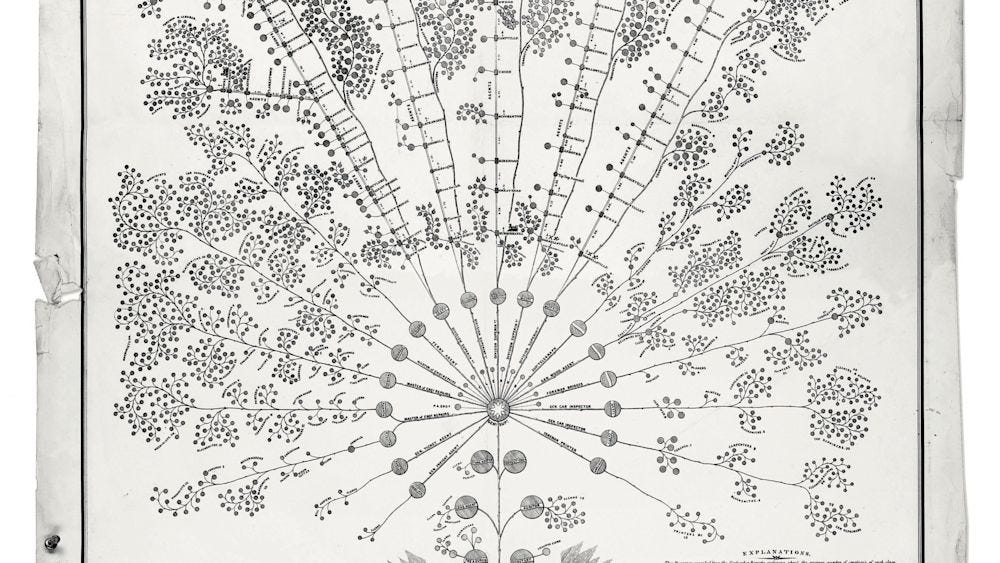
In 1855, Daniel McCallum had a problem. As General Superintendent of the New York & Erie Railroad, he was responsible for over 5,000 workers spread across hundreds of miles of track. He needed a way to see who was responsible for what, and how accountability flowed across the system. So he commissioned the world’s first organizational chart, a sprawling, hand-drawn diagram that mapped every functional office by name.
McCallum’s chart was inverted. Leadership sat at the bottom. Workers branched upward and outward like a living tree. It looked more like a root system than a pyramid.
It didn’t last. By 1911, Frederick Taylor had formalized hierarchy as management doctrine in The Principles of Scientific Management, splitting organizations into thinkers (management) and doers (workers). By the 1920s, Alfred Sloan had built the multi-divisional structure at General Motors that would become the template for large corporations worldwide. GM’s market share rose to 42% while Ford’s fell to 21%. After World War II, the management consulting boom codified hierarchical structure as universal best practice. McKinsey, BCG, and their peers didn’t just give advice. They exported their own internal hierarchies as the model for everyone else.
And that’s roughly where we’ve stayed.
Every significant attempt to displace the hierarchical org chart has either failed outright or remained confined to a niche. Matrix organizations in the 1960s added a second axis of hierarchy but couldn’t escape the fundamental logic of the pyramid. Tom Peters questioned bureaucracy in 1982 but didn’t propose a structural alternative. The flat organization discourse of the 1990s mostly remained discourse. The Agile Manifesto in 2001 produced the most successful structural innovation since Taylor, and it largely stayed within software teams. Holacracy and Teal organizations generated high-profile experiments in the 2010s, but when Zappos went fully holacratic in 2014, 18% of employees took buyouts within a year, the company dropped off Fortune’s Best Companies list, and managers quietly returned by 2018.
The org chart is the single most un-innovated object in business. Everything else about how we work, communicate, build, sell, move money, store and process information, has been subject to repeated waves of reinvention. But not the org chart, the implicit operating system everything you do runs on. We’re running a technology designed for railroad coordination, applied to knowledge work, and expected to carry us into an AI-accelerated future.
I don’t think it will.
Every technology eventually encounters the problem it can’t solve. The hierarchical org chart solved coordination at scale during the industrial era. It’s now failing to solve the problems of speed, complexity, and adaptive response the current moment demands. And this is a technological argument, not a moral one—which makes it harder to dismiss.
The org chart is more than a reporting structure. It’s the operating system on which every other organizational function runs. Purpose, strategy, authority, compensation, how you run meetings, how you allocate resources, how you define mastery: all of it is configured on top of the org chart. It’s the substrate. When the substrate is obsolete, everything running on it is constrained by that obsolescence, whether you can see it or not. You could probably run Claude Code on Windows XP, but why? At what cost?
This explains why most attempts at organizational transformation fall short. Leaders pick one dimension—structure, or culture, or strategy—and try to modernize it while leaving the rest unchanged. It’s like someone who goes to the gym religiously but only works their upper body and never trains their legs. The imbalance isn’t just inefficient. It’s visible. It breaks down under load. You can’t run a trust-based authority model on top of a control-based information system. You can’t practice emergent strategy while your resource allocation still requires six layers of approval. The dimensions of an organization form a system. They evolve together or they create dysfunction at the interfaces.
So that’s what this piece examines—the whole system, all twelve dimensions of how an organization operates, traced through a single systemic shift: from control-based coherence to trust-based coherence. I’m drawing on Aaron Dignan’s OS Canvas from The Ready and reinterpreting it through a lens I’ve been developing around decentralized organization, adaptive practice, and system-level thinking.
The old system holds together through rules, permission, positional authority, and fixed strategy. The emerging system holds together through shared purpose, protocol consent, distributed intelligence, and continuous sensing.
If that sounds too philosophical, then let’s make it about money. Stephen M.R. Covey’s research in The Speed of Trust established that trust is a quantifiable economic variable. Low trust creates friction—approval chains, oversight layers, redundant process, error correction. High trust removes it. Data from Great Place to Work shows that high-trust companies generate $883,928 in revenue per employee versus a U.S. market average of $104,030. Fortune’s 100 Best Companies to Work For have delivered nearly three times the cumulative stock return of the Russell 3000.
Trust-based coherence is materially faster and cheaper than control-based coherence. That’s an argument even skeptics have to contend with.
How power drives everything
The most fundamental transformation is happening in three interlocked dimensions: how authority is distributed, how structure is conceived, and how strategy is practiced. I’m starting here because if these don’t change, nothing else can.
Authority in the traditional model is positional. You have it because of where you sit in the hierarchy. Decisions flow upward for approval and downward as directives. The result is a permission-based culture where people wait to be told they can act.
A regional manager who knows exactly what her market needs, but can’t move until three levels of leadership review a proposal that will be outdated by the time it’s approved. A product team that spots a competitive threat in January and gets budget authorization in September. The distance between seeing and doing is filled with permission-seeking, and that distance is where opportunities go to die.
The shift I’m advocating is from positional authority to protocol-based authority: from “who has the title” to “what does the situation require.” The latter can almost always be determined better by the people doing the work. We have to be honest with ourselves here: if you can describe how you made a decision, you don’t need to be making it.
Frederic Laloux’s advice process, documented across dozens of organizations in Reinventing Organizations, works like this: anyone can make any decision, provided they seek input from those with expertise and those affected by the decision. You don’t need permission, but you can’t act in isolation from accountability. The principle of subsidiarity—decisions made at the lowest level capable of making them well—has roots in Catholic social teaching and is now central to decentralized organizational design.
And yes, protocols can be as oppressive as hierarchies if designed by a small group and imposed on others. “Consent to protocol” is hollow when there are no genuine exit options or mechanisms for the protocols themselves to evolve. This is where Holacracy’s governance process offers something valuable: an answer to the question, who governs the governance?
Structure follows authority. If authority is distributed, structure has to be too.
Consider how most mid-sized companies are actually organized: a CEO with five to eight direct reports, each running a functional silo, each competing for resources, each optimizing locally in ways that create friction globally. Marketing doesn’t talk to product. Sales promises things engineering can’t deliver. Strategy is set at the top and translated—which is to say, distorted—through each successive layer until it reaches the people doing the work. The boxes and lines on the org chart aren’t just a diagram. They’re a prediction of where communication will break down.
Stanley McChrystal’s Team of Teams provides the most compelling evidence that distributed structure works even in domains where hierarchy seemed non-negotiable. When McChrystal restructured Joint Special Operations Command from a traditional military hierarchy to a network of empowered teams with shared consciousness, task force operations went from approximately four raids per month to three hundred. Not 4% more. Not 40% more. Roughly 7,500%.
This is what Buckminster Fuller meant: you don’t change things by fighting the existing reality. You build a new model that makes the existing model obsolete. Organizations that adopt distributed structures won’t win arguments about hierarchy. They’ll just outcompete organizations that don’t.
But this thinking has existed for thirty years. Buurtzorg, Haier, W.L. Gore, Valve, Semco: successful distributed organizations aren’t new. So why haven’t these models spread?
Because organizations don’t change until not changing hurts more than changing does. For three decades, the pain was manageable. Traditional structures were slow but functional. The cost of organizational debt—the accumulated layers of management, approval chains, and process bureaucracy—was overhead, not existential threat.
That calculus is shifting beneath your feet right now. AI is compressing the competitive timeline. When a solo founder can run a $14 million annual revenue company, or a small team can match the output of departments, the ability to coordinate large numbers of people stops being a moat and starts being a weight. Small business AI adoption rates have nearly quadrupled from 14% to 55% between 2023 and 2025. You think you know who the competition is, but you might be wrong. It might be a company started last year with three people and no organizational debt at all.
Strategy is where power meets direction. The traditional model treats it as a destination: a three-year plan with milestones, approved by the board, cascaded through the organization. The annual strategic planning cycle that consumes six weeks of executive time to produce a document that’s already being revised by Q2. OKRs set in January that everyone quietly abandons by March because the market moved. Strategic initiatives that were the right idea eighteen months ago but are now organizational momentum no one knows how to stop.
Henry Mintzberg named this decades ago: most successful strategies were never fully planned. They emerged through a combination of intention and adaptation. It looks a little like the difference between football and basketball. Football is a planned game (huddle, call the play, execute, stop). Basketball is continuous play—improvisation within structure. We’re in constant motion.
This is not an argument for drift. Rivers reach the sea. Organizations that experiment but never follow through lose the compounding benefits of continuous learning. The discipline is holding both—adaptive responsiveness and the persistence to see things through.
How intelligence gets distributed
This is where things get personal. The shift in these next four dimensions—information, mastery, workflow, meetings—directly threatens the identity of every leader who built their career on knowing things.
Think about how information actually moves in your organization. It flows up through reports, gets filtered at each level, arrives at the top compressed and sanitized, and decisions flow back down based on that degraded signal. Your CEO is making calls based on what survived the journey through five layers of summarization. Meanwhile, the person closest to the customer—the one who actually heard what the customer said—is four reporting levels away from anyone who can act on it.
AI handles propositional knowledge at speeds we can’t match. The facts, the data, the reports—that’s compute now. The meaningful human information becomes something different: what’s happening in the organization, where the energy is, what patterns are forming, what feels stuck. Meta-information. Sensemaking.
James Surowiecki identified four conditions for collective intelligence: diversity of opinion, independence, decentralization, and aggregation. AI now owns aggregation. The first three require organizational design. Which means the human contribution to organizational intelligence isn’t knowing things anymore. It’s creating the conditions under which diverse, independent, decentralized perspectives can surface.
There’s a tension here, and it cuts both ways. Goodhart’s Law: when a measure of organizational health becomes a target, it ceases to be a reliable measure. And continuous organizational sensing slides easily toward surveillance. Both deserve more than lip service.
Now look at what this does to mastery. For decades, mastery meant depth: the 10,000-hour expert, the person who’d seen every variation of a problem within their domain. Organizations hired for credentials and promoted for tenure.
That’s dissolving.
When AI can access and process the entire corpus of explicit knowledge in a field, “I’ve memorized the most” stops being a value proposition. Michael Polanyi draws a useful distinction: explicit knowledge (codifiable, compressible into a database) versus tacit knowledge (embodied, experiential, demonstrable only in practice). AI handles explicit knowledge thoroughly. The mastery that remains irreplaceable is tacit—pattern matching across domains, reading a room, sensing where there’s energy and moving toward it, cultivating relationships that surface intelligence no system can extract.
David Epstein’s research in Range reinforces this: in complex environments where the rules aren’t fixed, generalists with cross-domain pattern recognition consistently outperform narrow specialists. The future of mastery is recognizing patterns the data doesn’t show you.
If that makes you uncomfortable, good. Sit with it. It should.
Workflow shifts accordingly. Every organization has processes that exist because someone made a mistake once and the response was a new rule. Over time, these accumulate. The expense report that requires three approvals for a $50 lunch. The procurement process designed for million-dollar purchases applied identically to buying a $200 software subscription. The onboarding checklist with forty-seven steps, twelve of which are redundant and six of which no one has updated since 2019.
If AI handles variation and exceptions—which is precisely what it’s becoming capable of—then rule-heavy infrastructure built to substitute for human judgment is dead weight. Gary Hamel’s argument for minimum viable process: keep only the procedures genuinely necessary for safety or coordination. Let principles replace rules.
But not everywhere. Ken Wilber’s “transcend and include” is a useful concept. Even as we move more fluidly, there are places where variation kills. Safety-critical domains like medicine, aviation, and nuclear operations should retain standardized workflows. But we need to decide whether standardized workflow is the default or one option among several.
And meetings? Meetings are the canary in the coal mine.
I bet you’ve been in one of these: eleven people in a room, eight of them checking email while two present slides containing information everyone could have read in advance. Monday status updates where each department head recites what their team did last week. QBRs that take four hours and produce no decisions.
These meetings exist because the organization’s information system can’t do its job, so humans are conscripted to be the network. When AI handles information aggregation, all of that is waste. What’s left is what humans do that machines can’t: meaning-making, relational work, and what I’d call organizational health—attending to the functioning, energy, and coherence of the group itself.
If your meetings changed and nothing else did, you’d know the transformation was performative. But if your meetings changed because your information systems, your authority structures, and your definition of mastery all changed too—that’s a different organization.
How value flows
Five dimensions describe how value moves through an organization: purpose, membership, innovation, resources, and compensation. And this is where I need to be honest with you about what we know, what we’re guessing, and what nobody has figured out yet.
Purpose first. In the traditional model, it’s a plaque on a wall. “Our mission is to deliver innovative solutions that empower our customers.” You’ve read hundreds of these. They could belong to any company in any industry. They’re inert—they don’t orient decisions, don’t survive contact with reality, and don’t evolve as the organization learns. And they describe a destination without answering “…and then what?”
I believe a real strategic move is replacing purpose statements with purpose questions. Questions are regenerative. They don’t lead to fixed points; they lead to iteration and adaptation. “How might we...” is a fundamentally different organizational technology than “Our mission is to...” Laloux’s concept of living purpose takes this further: purpose that listens for what wants to emerge, held lightly enough to evolve.
But there’s a caveat: purpose questions become theater the instant the organization isn’t genuinely willing to be changed by the answer.
Membership is where the organizational border starts to dissolve—and where some of the most interesting value creation is already happening. As organizations decentralize, the line between inside and outside blurs. It looks like Kevin Kelly’s 1,000 True Fans thesis: deep engagement from a small, passionate community creates more value than passive reach from a large one.
LEGO Ideas has 2.8 million contributors submitting product ideas, voting on designs, and collaborating on development. The program generates roughly $90 million in revenue with 40% EBIT margins and a 90% first-release sell-out rate. That’s what it looks like when membership extends beyond payroll.
Innovation connects directly. Eric von Hippel’s research shows that in many industries, 10-40% of users develop or modify products before manufacturers do. They live at the edges of existing knowledge, where the adjacent possible is visible. They see what’s next before you do.
Yes, some breakthrough innovations—the iPhone, the Walkman, the Post-it note—didn’t come from customer listening. Visionary innovation may require something different. But how much of your R&D budget is going toward breakthroughs, and how much is going toward adaptive improvements your community would happily co-create for free?
Resources shift from political allocation to consent-driven distribution. Be honest: in your company, does budget season reward the best ideas or the best politicians? The VP who has the CEO’s ear gets funded; the team with the best data doesn’t. Departments defend headcount, inflate projections, and hoard allocations because they’ve learned that what you don’t protect gets taken.
The Buurtzorg model is what happens when you do it differently: self-managing nursing teams of 10-12 control their own budgets with near-zero central oversight. Care hours per patient run 50-67% below competitors. Overhead sits at 8% versus an industry average of 25%. Highest patient and employee satisfaction scores in the Netherlands. It works because teams are small and close to consequences—they feel the effects of their own decisions directly.
Collective allocation has real limitations, though. It can be slow, it can reward popularity over strategic merit, and some resources genuinely need system-level coordination. You can’t vote on server infrastructure. But the current model has limitations too, and we’ve just stopped noticing them.
And then there’s compensation. I’m going to be direct: this is the dimension where I have the most uncertainty, and I think anyone who tells you they’ve solved it is selling something.
The time-for-money exchange—the hour as the unit of value—is a dead concept. Hourly work is a fool’s game. AI is making that undeniable. Emad Mostaque’s “proof of benefit” framing points in a direction: compensation tied to demonstrable contribution. But contribution-based models consistently struggle to capture invisible work, disadvantage caregiving-constrained workers, and tend toward winner-take-all dynamics. We’ve tried. It’s hard.
The strongest evidence comes from cooperatives. Mondragon, the Basque cooperative network, has operated for sixty years with a maximum 6:1 pay ratio and has never fired a member. ESOP companies grow 2.3-2.4% faster and show higher survival rates. These aren’t answers. They’re signals. And the honest truth is that we’re still searching.
I flag this because it matters: when we get to the deep-dive on compensation in a future piece, I expect it to be the hardest one to write. That should tell you something about where we are.
The compounding weight of waiting
Software engineers talk about technical debt—the accumulated cost of shortcuts, patches, and decisions that made sense at the time but now slow everything down. Organizations carry the same thing. Every layer of management added for coordination, every approval chain built for control, every process designed to compensate for low trust: deposits in an organizational debt account that compounds over time.
For decades, that debt was manageable. The interest payments showed up as slower decisions, higher overhead, frustrated talent. Real costs, but survivable.
What’s changed is the interest rate.
AI is compressing the competitive timeline. The window between sensing an opportunity and acting on it has never been narrower. The cost of slow hierarchical decision-making was expensive before. Now it’s potentially fatal.
And the organizations most at risk aren’t the ones you’d expect. Large enterprises have resources to absorb pressure and fund transformation. It’s mid-sized companies—successful enough to have accumulated significant organizational debt, too small to have the reserves for wholesale restructuring—that face the sharpest threat from AI-native entrants carrying none of that weight.
It’s pressure that’s building right now, in your market, whether you’ve named it or not.
The system I’ve described across these twelve dimensions has nothing utopian about it. Self-directed structures require intentional design and constant nurturing. Distributed authority creates new coordination challenges. Trust-based coherence demands more of people, not less. Ken Wilber’s “transcend and include” is the right frame: the old doesn’t disappear. Command-and-control remains useful at specific scales and in safety-critical contexts. But it kills companies everywhere else.
Are you addressing reality or stuck in theatre?
If this piece has done its job, you’re not thinking about organizational design in the abstract anymore. You’re thinking about your company. So here are some questions. They’re not a scorecard. They’re a mirror. Sit with the ones that make you uncomfortable, because that’s where the work is.
On how power moves: Do decisions in your organization require permission from someone who won’t live with the consequences? When the people closest to a problem see the answer, how many layers stand between seeing and doing? Is your strategic plan a living instrument or a document that lives in a drawer until the next planning cycle?
On how intelligence distributes: Could your newest hire explain what your company actually does, and why, with no reference to a mission statement? How much of your meeting time is spent transferring information that could have been read in advance? When someone spots a pattern or a problem, can that signal reach the people who can act on it before it’s been filtered, softened, or lost?
On how value flows: If you stopped paying your most engaged customers, partners, and community members, would they still show up? Are your best ideas coming from inside the building or from the people closest to the problems you solve? Does your compensation model reward the people who create the most value, or the people who are most visible to leadership?
And the systemic question—the one that matters most: If you transformed one of these dimensions tomorrow—gave teams real authority, or redesigned your meetings, or opened your innovation process to your community—would the rest of your organizational system support it? Or would it snap back like a rubber band, because everything else still runs on the old operating system?
That last question is the whole point. The dimensions are a system. They evolve together or they don’t evolve at all.
In the coming months, I’ll be going deeper on individual dimensions: dedicated pieces on each transformation, with the case studies, tensions, and practical implications that a system-level view can only gesture at. If this piece maps the territory, those will be the expeditions.
The org chart is 170 years old. It’s time to build what comes next.


Thanks Joseph.
The org chart is not the root problem IMO. It is a visible artifact of a deeper constraint: authority, information and intent are vertically mediated. The pyramid persists because coordination, accountability and resource allocation require a substrate. Hierarchy solved scarcity of information and slow communication. That constraint no longer dominates.
Project 'SHシFT' doesn't “flatten” the org chart. It changes the substrate beneath it.
Railroad logic:
- Authority = position
- Information = filtered upward
- Strategy = cascaded downward
- Value = assigned by role
SHシFT logic:
- Authority = proximity to intent and consequence
- Information = broadcast at origin
- Strategy = emergent from live signals
- Value = demonstrated through contribution
The structural shift is from reporting lines to signal lines.
In a hierarchy, intelligence moves through managerial compression. In SHシFT, intelligence moves through declared intent. When a human states direction, constraint, or problem upstream, before it is role-shaped - the organization can route around silos. This is protocol coherence, not positional coherence.
The article frames the shift as control → trust.
SHシFT reframes it as inference → declaration.
Most companies infer what people want from titles, KPIs, departments, CVs, OKRs. That is railroad technology. It assumes stable roles and slow change.
SHシFT captures first-person intent as a live data layer. That becomes a routing mechanism for:
- collaboration
- resource pull
- problem aggregation
- capability discovery
You do not abolish hierarchy. You reduce its informational monopoly.
That's why most “flat” experiments fail. They attempt structural redistribution without changing signal infrastructure. Authority is redistributed but discovery remains siloed. So, the system snaps back.
If intent becomes machine-readable and continuously broadcast:
- decisions can localize without permission chains
- expertise surfaces without managerial mediation
- communities form around problems, not departments
- resource allocation can follow declared demand signals
This is closer to a network protocol than a management theory.
Railroad tech optimized for command and control over distance.
SHシFT optimizes for alignment over complexity.
The org chart becomes secondary metadata. The primary operating layer becomes:
Who is moving where?
Who is stuck?
Who is declaring what?
In an AI-compressed environment, coordination advantage no longer comes from scale of headcount. It comes from speed of coherent reconfiguration.
Hierarchy is slow because information is slow.
If signal moves first, structure can adapt instead of defend.
That is the real shift.
SHシFT is not anti-organization. It is post-railroad organisation.
I'd like a future in which communities cocreate innovation not for free but as collective owners, with that effort tied to contribution as well.
That was one of the promises of blockchain and NFTs but things there seem to be usurped by old models and money grabbers.
I still believe there is a future in which we collectively win, and I'm present to how intractable the old models feel.