What coaching's numbers are hiding
Everyone in coaching is reading the same report. Almost no one is reading it right.
Every now and then I talk about coaching. It’s what I do, after all.
Today’s one of those days. I’ve started to see some signals that look very different than the ones I’m seeing on LinkedIn and hearing from coaches.
The International Coaching Federation released its 2025 data last month. Global coaching revenue: $5.34 billion. Up 17% from 2023. Growth market, right?
The press releases wrote themselves. The LinkedIn posts followed. Conference keynotes are being assembled around it as you read this.
Here’s what those numbers don’t show.
I’ve spent 17 years working with founders and executives. I run a structural projection framework called Hari, refined over about a decade of applied pattern recognition, that maps causal chains, identifies thresholds, and projects what happens next before the consensus view has caught up. Three weeks ago I applied it to the coaching profession.
What I found runs directly against the headline.
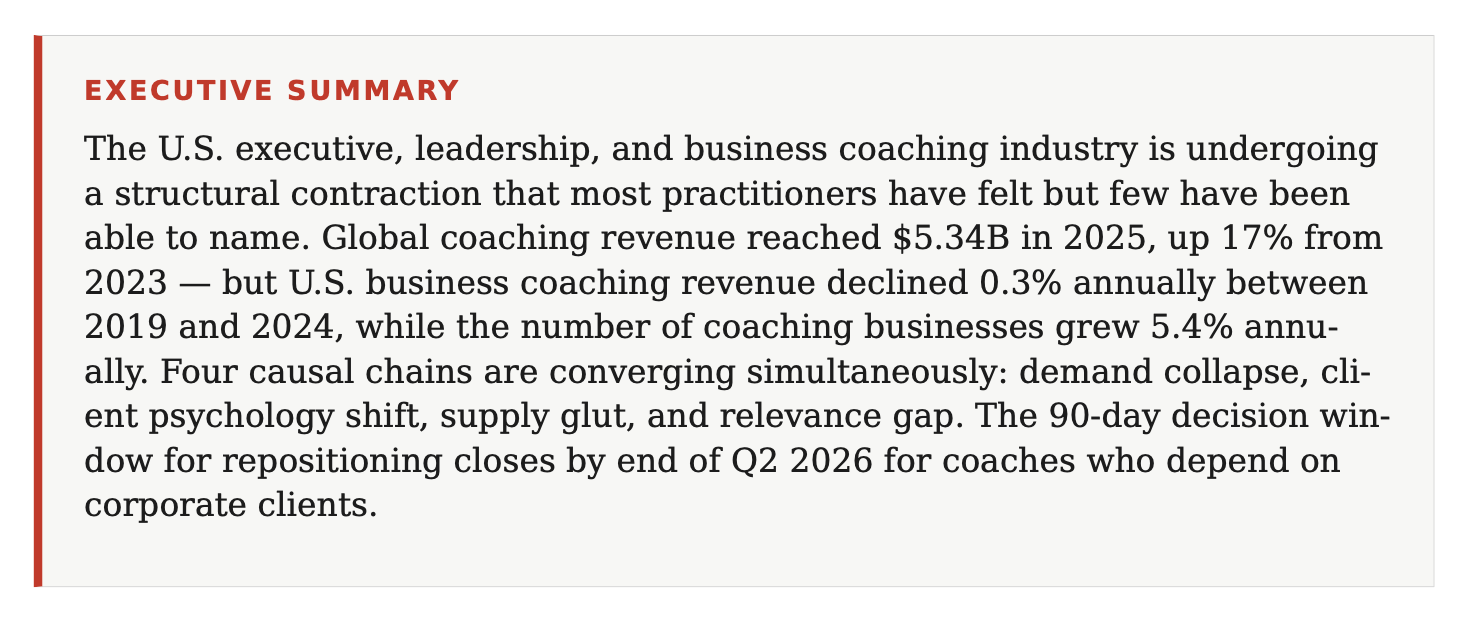
That $5.34 billion includes BetterUp, CoachHub, and roughly forty other AI coaching platforms that didn’t exist five years ago. BetterUp alone is projecting $500 million in revenue this year. Pull the platforms out and look at the number underneath (it looks a lot like the S&P 500 when you pull the Mag7 out). U.S. business coaching revenue for independent practitioners declined 0.3% annually between 2019 and 2024. The number of coaching businesses grew 5.4% annually over that same period.
More coaches. Less money.
I track four causal chains. Each one is a problem on its own. All four are running simultaneously, right now.
Part 1: The companies that buy coaching are cutting.
1,206,374 job cuts in 2025. Highest annual total since 2020. January 2026 brought 108,000 more, the highest January figure since 2009.
Those are the CFOs who froze the L&D budget. The CHROs who had to explain to their board why they were still paying for external coaching while cutting headcount. When organizations are in that kind of pressure, discretionary development spending goes first. Per-employee learning hours dropped 21% in a single year, from 17.4 to 13.7. That’s not a budget cycle. That’s a decision about what coaching is worth to them.
Part 2: The clients who remain are carrying something different.
Here’s something Hari tracks that the ICF data doesn’t: client psychology shift. The change in what clients actually need versus what the market is offering them.
That gap is wide right now.
A client whose department just lost 30% of its headcount comes into a session with a specific kind of pressure. They want to know what to do in the next 90 days. They want to understand the political dynamics of a contracting organization. They want to figure out how to position themselves in a role that may look nothing like this within a year.
The coaching modality that built most established practices was designed for a client with stability and bandwidth. Stable employment. A clear career trajectory. Room to explore. The question “What would your ideal life look like?” is a powerful one, in the right conditions. The problem is the conditions have changed, and most practices haven’t. The mismatch doesn’t announce itself. It shows up as clients who reschedule, then reschedule again, then quietly stop.
Part 3: There are simply too many coaches.
ICF membership grew 73% between 2019 and 2023. Coaches who enrolled during the pandemic, drawn by the reasonable belief that coaching was a growth profession, are now entering active practice precisely as corporate demand contracts. They arrive credentialed and without clients, competing against established practitioners for fewer engagements.
More than 53% of coaches globally earn less than $30,000 from coaching. First-year coaches average $14,484. The income distribution is a cliff, not a curve.
Part 4: The organizational problems clients face now are ones most coaching frameworks weren’t built for.
AI-driven workforce restructuring. Compressed decision cycles. Strategic uncertainty that outpaces the strategy deck. The clients who remain are navigating complexity that accelerated faster than most frameworks evolved to address.
The coaches who hold their clients through this are the ones who can engage with that complexity at the strategic level. That’s not a weekend workshop on AI tools for coaches. It’s genuine understanding of what AI is doing to organizations, and what that means for the person sitting across from you. The coaches whose frameworks were designed for stable career paths are watching clients disengage. They attribute it to the market. Some of it is the market. Most of it is the gap between what the framework offers and what the client actually needs.
The client doesn’t say this. They just stop scheduling.
The consolidation is underway. The 90-day repositioning window closes by end of Q2. The corporate evaluation cycle for external coaching partners runs annually, with mid-year reviews. Coaches who haven’t updated their offering by the time those reviews happen won’t be renewed. The structural math, unlike the press releases, doesn’t negotiate.
I want to name what makes this hard to act on. The aggregate data is genuinely mixed. The $103 billion global market projection is real. The 87% positive ROI finding is real. The complexity that’s restructuring organizations does create demand for sophisticated human guidance. None of that is false.
It just doesn’t reach the indie practitioner the way the industry associations present it.
I applied my own framework to my own profession and saw a big gap, one we know how to respond to. Professionals who read structural signals early enough to act on them tend to come through consolidations better than those who wait for the consensus to confirm what was already visible.
The structure is visible now.
If you want to see where your specific practice sits in these four chains before the Q2 window closes, I'm running a limited pilot of a self-administered diagnostic. You'd get the same structural map I build before a first session. Details here: form.typeform.com/to/QlPtNfbL


