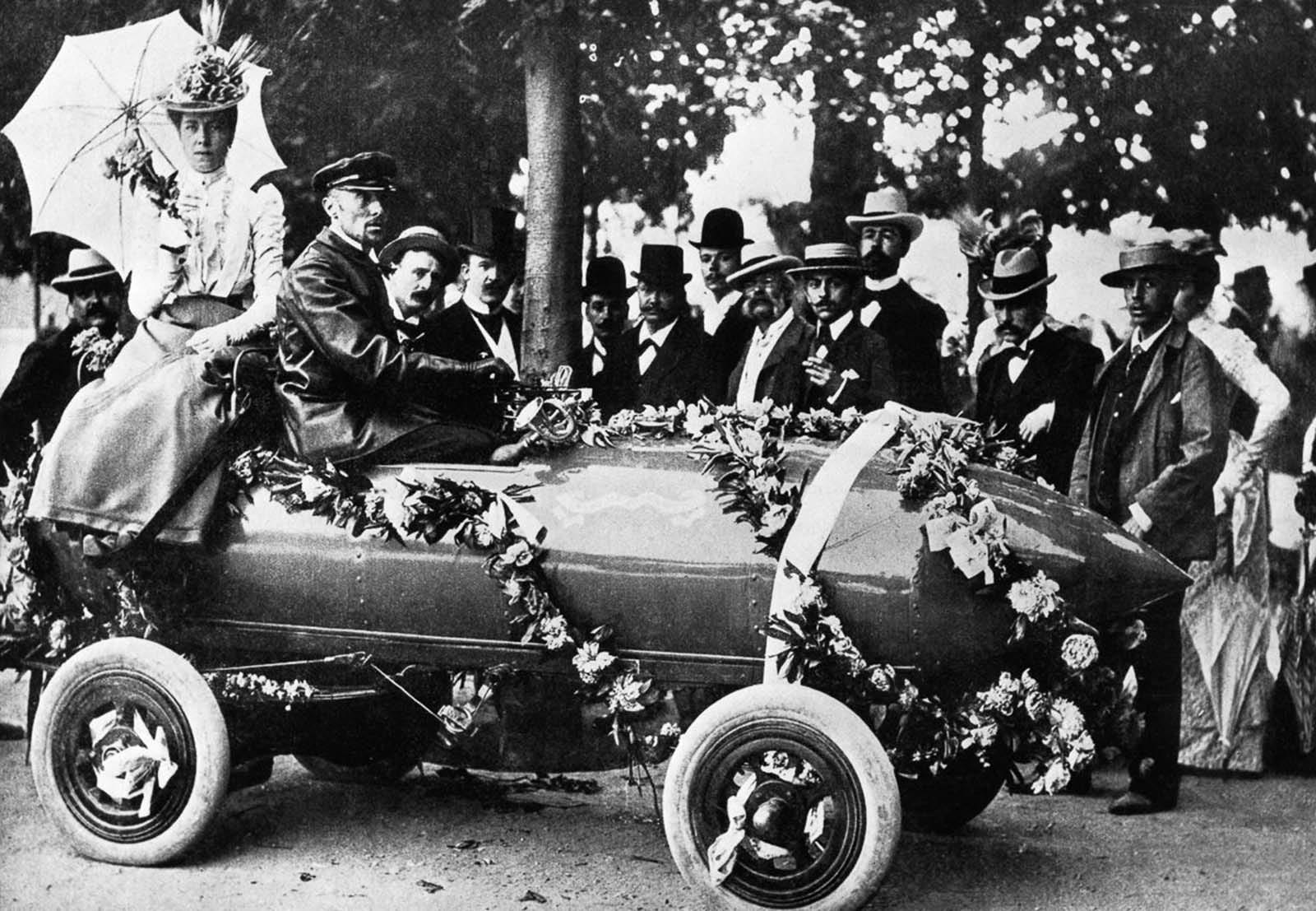
The teenager was not a faster horse
We're arguing about how big AI will be. The last 100 years say that's the wrong question.
In 1898, the smartest urban planners in the world got together to solve the biggest problem facing every major city, and they gave up.
The problem was horse manure. New York had something like 170,000 horses moving people and goods, and each one produced more than twenty pounds of the stuff a day. The streets were buried. Dead horses, about 15,000 a year in New York alone, were left to rot until they were easy enough to cut up and haul away. So the first international urban planning conference convened in New York to figure out what to do. It was scheduled for ten days. It broke up in three. Nobody could see a way out.
They weren’t stupid. They had the best data, the sharpest minds, the most direct possible motivation to find an answer. And the answer was already being built in workshops a few miles away. But it didn’t look like an answer. It looked like a toy for rich men. What would eventually dissolve their unsolvable crisis wasn’t a better way to manage horse poop. It was the end of horses, and they couldn’t see it because they were living in a world that horses had built.
I do this kind of work for a living now. Not solving horse poop, but rather projecting how structural forces play out before they show up in indicators we understand. That conference gets my synapses firing, and not because it’s a cute story about manure. It’s the clearest example I know of a specific kind of blindness. It looks a lot like the way we’re thinking about AI.
We’re arguing about the wrong thing (again)
Open any feed and you’ll find the same fight. One camp says artificial general intelligence (AGI) is arriving in two or three years and almost nobody is pricing it in. The other camp says it’s hype, the productivity numbers are flat, call me when a model can do my taxes without inventing a deduction. They argue about size. They argue about speed. How big, how fast, how soon.
I think they’re both missing it, and they’re missing it in the same way the manure conference missed it.
Plenty of people expect enormous change. The error is assuming the future will be a recognizable version of the present, just more of it. Faster. Cheaper. Scaled up. We picture the same world we have now, running on better engines.
That’s almost never how it goes. The real change shows up sideways, in a form the current model of the world doesn’t have words for yet.
Let me show you what I mean with the cleanest case in the record. It isn’t the car. It’s what powered the building you’re sitting in.
The forty-year shrug
Electricity arrived, and for about forty years it did almost nothing.
That sounds wrong, but it isn’t. Edison opened his first power station in Manhattan in 1882. By 1899, after seventeen years, electric motors ran less than five percent of the mechanical muscle in American factories. The big productivity surge didn’t arrive until the 1920s. That’s two human generations between invention and payoff.
Why so slow? Because factory owners did the obvious, sensible, intelligent thing. A factory in 1890 was built around one giant steam engine in the basement, turning a system of shafts and belts that ran up through the floors and drove every machine in the building. When electricity came along, owners pulled out the steam engine and dropped in one big electric motor. Same shafts. Same belts. Same building. They electrified the factory they already had.
And they got very little for it. The motor was cleaner. The coal bill dropped. That was about it.
The actual revolution took another thirty years and required someone to understand something that in hindsight is obvious and at the time was nearly invisible. You don’t need one big motor. You can give every machine its own small one. And once each machine carries its own power, you don’t need the entire building organized around a central shaft anymore. You can spread the factory out, put it on one floor, arrange the machines in the order the work actually flows, add windows, add light. You can invent the assembly line.
Output per hour roughly tripled, and it tripled when factories stopped electrifying the old design and started building a new one around what electricity made possible. The unlock wasn’t the motor. It was the redesign the motor eventually permitted, something nobody imagined until somebody built it.
The people running those factories had electricity for forty years. They weren’t waiting for the technology to get better. They were waiting for imagination, and imagination is the hardest thing to rush because you’re trying to picture a building you’ve never been inside while every building you’ve ever been inside feels right.
If that sounds familiar, it should. We’re doing it right now. Most companies “adding AI” are bolting a motor onto the old factory. Same workflow, same org chart, same software, now with a chatbot welded to the side. We’re in year three of the shrug. The redesign hasn’t been imagined yet. When it is, it won’t look like our work plus AI. It’ll look like something we don’t have a name for, and the people who saw it first will seem in retrospect to have been stating the obvious.
(Speaking of seeing it first, Ethan Mollick tweeted this today: “Decisions about how to use AI in your organization are increasingly organizational design and strategy decisions, not IT choices: How do you integrate agents into your firm? What intelligence will you outsource? What are the boundaries of the firm? What is the role of people?” Those look like imagination questions.)
Car culture and teenagers weren’t on the forecast
Which brings us to the car and the line that gives this piece its title.
You know the Henry Ford quote, the one about how if he’d asked people what they wanted they’d have said faster horses. He almost certainly never said it. The earliest version anyone can find showed up in 2001, more than half a century after he died. It’s a good line because it flatters us. It says the public lacked vision and the genius saw the car. It’s tidy. And it’s wrong in an instructive way.
Even the people who did see the car, who bet everything on it, who got rich on it, didn’t see what the car actually was. They saw a horseless carriage. The name itself reflects how limited imagination was. It defines the new thing entirely by the old thing it replaces, the way we say “wireless” or “horseless” or, give it a few years, “driverless.” The framing borrows its vocabulary from an obsolete world.
The new reality looked a lot different. The car gave us the suburb, which gave us the commute, which rearranged where Americans live and how cities are shaped, to the point where we passed zoning laws making it illegal across most of the country to live within walking distance of a shop. It gave us a new category of death; American traffic fatalities have now passed roughly four million cumulative, a kind of dying that didn’t exist in 1899. It gave us oil geopolitics, the whole bloody century of it, traceable to a manure problem a conference couldn’t solve.
And it gave us the teenager.
I mean that almost literally. Before the car, you were a child and then, fairly abruptly, you were an adult with adult work. Adolescence as a distinct stage of life, with its own culture and its own freedoms and its own anguish, barely existed. Then teenagers got cars. A car is a private room that moves. Courtship left the family parlor and went somewhere parents couldn’t follow. Youth culture formed around the things cars made possible: the drive-in, the cruising strip, the date, and a new kind of person appeared in the world. The word “teenager” didn’t come into common use until the 1940s because it wasn’t a thing before World War II.
Think about the existential strangeness of that. A machine for moving goods faster than a horse reached into the structure of the human life course and invented a new stage of being alive. Nobody at the auto show pitched it that way. Who could have? It was three steps downstream from the engine in a place the engine’s inventors had no way to see.
We should pay attention to that. Transformation never lives in the technology. It lives in the second and third effects the technology eventually makes possible, and those things are the ones you can’t see from the now.
Why we can’t see it from here
There’s a reason this blindness is so consistent, and it isn’t a lack of intelligence.
Every working model of the world becomes, over time, invisible to the people living inside it. The economic historian Carlota Perez puts it well: a way of doing things eventually turns into “common sense,” and then it goes “unconscious and invisible,” and once it’s invisible you can’t evaluate it, because the tools you’d use to judge it were built by it. The fish doesn’t know it’s wet. The factory owner can’t see that the building is the problem. The planners at the conference can’t see past the horse.
This is the hard stuff. You can’t reason your way to the next world from inside the current one using the current one’s logic. The new arrangement isn’t a conclusion you reach by thinking harder about the old arrangement. It’s a different starting point, and from where you are right now it looks less like an answer and more like a toy, or a threat, or nonsense. The people who got it first usually didn’t out-argue everyone else. They had a different perspective, or they were young enough not to have fully absorbed the old one, or they got lucky. The inner model has to shift before the outer world becomes visible, and that shift isn’t something you can force by accumulating more facts about the world you already know.
That’s what’s uncomfortable about the AI argument. The expertise that makes someone authoritative about the current model of work is the same expertise built for the world that’s changing. It’s not that experts are dumb. It’s that mastery of the present is poor preparation for seeing the thing that ends it. In 1998 one of the most decorated economists alive predicted the internet’s effect on the economy would be no greater than the fax machine’s. He wasn’t careless. He was applying excellent tools to something those tools weren’t built to measure. We mistake the noise of an early transition for its destination. Every time.
What this means for the argument we’re having
So when I watch the timeline fight, the two-years-versus-twenty debate, I think we’re measuring the wrong axis.
How big or how fast AI is doesn’t matter much. Change has a different shape. What’s the suburb of AI? What’s the traffic death of AI, the new kind of harm that doesn’t have a name yet? What’s the oil geopolitics, the thing three steps downstream that reorganizes power? And the one that gives me equal parts excitement and vertigo: what’s the teenager of AI? What new category of human life, or work, or relationship, or selfhood is going to seem completely obvious to someone in 2070 and is, to us right now, literally unthinkable, because we don’t yet have the word?
I don’t know, and I’m mildly suspicious of anyone who tells you they do. The point is that it isn’t knowable from here. But I’ve come to believe the future is reliably weirder than we imagine, not bigger. The binding limit on understanding what’s coming isn’t compute or data or better forecasts. It’s imagination, which is what a working model of the world keeps mostly quiet.
I have a folder of this stuff. The printing press, which everyone treated as a faster way to copy the books they already had, right up until it cracked open the Church and helped manufacture the nation-state. The internet that turned into social media. The same shape, over and over, across five centuries.
If you want me to keep pulling this thread, tell me in the comments which one you want next, and I’ll write it (I’m working these into something longer, and subscribers will see the pieces first). I started this for myself to get clear on a hunch. It’s turning into a map of how we keep missing the future, and I’d like your help.
The horse people weren’t fools. They were us, looking at a toy in a workshop three years before everything changed and calling it a toy. Right now I believe we’re doing that again.


