The Productivity J-Curve
Why we see AI everywhere except in the economic data—and when that will change.
If productivity increases in the economy and no one measures it, did it happen?
I began this week with three somewhat counterintuitive propositions:
I do not believe there has been any meaningful job displacement by AI.
I do not believe there has been any meaningful job creation by AI.
I do not believe there have been any meaningful productivity gains from AI.
I noted that for each of these propositions, there is an implied “yet.” I believe all three will happen, and I’ve seen no compelling arguments to the contrary. I spend a lot of time thinking about “when,” and the answers for each of those three propositions have compelling stories arising from the differences between them.
Over the last couple of days, I discussed the first two stories. I mapped the timing gap in job displacement, showing how a massive corporate severance buffer is currently masking the structural decline in white-collar headcount. Then I moved on to the abstraction layer, showing how the emerging “Orchestration Layer” will eventually create new work, but only after a painful 18-36 month “valley of retraining” that has already frozen early-career hiring.
Now it’s time for the third and most perplexing story: the productivity paradox.
If you spend any time on social media or in corporate boardrooms, this proposition sounds absurd. We’re bombarded with case studies showing that AI makes programmers 30% faster, customer service agents 15% more efficient, and writers 37% more productive. McKinsey tells us AI will add trillions to global GDP. PwC says it’s a productivity miracle.
But if you look at the actual macroeconomic data, the miracle is entirely missing.
According to the Bureau of Labor Statistics, private nonfarm business Total Factor Productivity—the true measure of technological efficiency—grew by just 0.8 percent in 2025. That’s a deceleration from 2024, and it’s well within the sluggish historical bounds of the last 15 years. At the same time, corporate America (mostly the Mag7) is deploying a staggering 700 billion dollars in AI capital expenditure this year alone.
We bought the most expensive shovel in human history, but we’re not digging any faster.
This is a repeat of the Solow Paradox of 1987, when Nobel laureate Robert Solow famously observed that “you can see the computer age everywhere except in the productivity statistics.” It took 24 years for the personal computer to show up in the aggregate U.S. productivity data.
You might reasonably wonder why this lag exists, how it works, and when it’ll break.
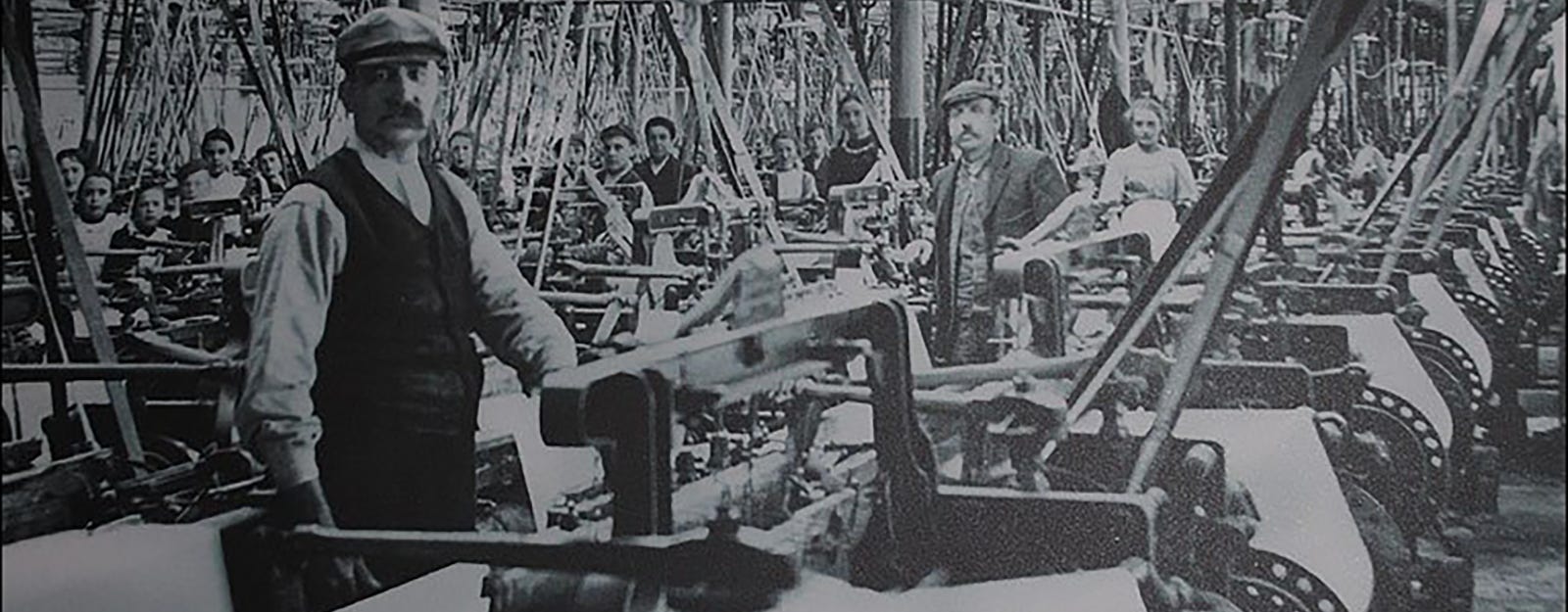
Factories with leather belts
To understand why seven hundred billion dollars of AI spending hasn’t moved the needle on GDP, we can look at the history of electrification.
When the electric motor was commercialized in the 1880s, factory owners were thrilled. They assumed they were about to see an immediate explosion in productivity. But for the next 30 years, manufacturing output per hour remained completely flat.
The bottleneck wasn’t the electric motor. It was the factory layout.
Early adopters of electricity simply engaged in direct tool substitution. They removed their massive central steam engine and replaced it with a single, large electric motor. But they left the rest of the factory exactly as it was: a labyrinth of vertical drive shafts, overhead pulleys, and leather belts distributing power from the ceiling down to individual machines.
The electric motor was cleaner and quieter, but it didn’t change the physics of the factory. There was still friction. Belts still slipped. Factory layout was still dictated by how close a machine had to be to the central drive shaft, not by the logical flow of the assembly line.
Productivity only exploded in the 1920s—four decades later—when a new generation of industrial engineers redesigned the factory floor from the ground up.
They built horizontal, single-story factories. They threw out the central shaft, the pulleys, and the leather belts. Instead, they gave every single machine its own fractional-horsepower electric motor. Now the layout of the factory could match the logical sequence of production. The continuous-flow assembly line was born.
That’s the transition we are stuck in today.
Giving an employee a ChatGPT license or a GitHub Copilot subscription is the modern equivalent of replacing a steam engine with an electric motor while keeping the leather belts. We’re substituting a new tool into an old process when the answer is to redesign the workflow.
The task-to-job bottleneck
The reason individual AI speedups don’t aggregate into macroeconomic productivity is simple: jobs aren’t single tasks.
If a software developer uses an AI assistant to write code 30% faster, that developer’s overall job-level productivity doesn’t rise by 30%. Writing code is only a fraction of their job. They still have to wait for code reviews from peers, attend daily stand-up meetings, coordinate with product managers, and debug legacy integration issues.
Because the non-coding tasks still move at human speed, they act as absolute structural bottlenecks.
In computer science, this is known as Amdahl’s Law: the overall speedup of a system is strictly limited by its serial, non-parallelizable portion. If 80% of a white-collar job consists of human coordination, meetings, and legacy software, even an infinite speedup on the remaining 20% of the work yields a maximum overall job-level productivity gain of only 25%.
A temporary behavioral phenomenon exacerbates that bottleneck: the on-the-job leisure leak.
When an individual task is accelerated, the time savings are frequently retained by the worker rather than captured by the firm. If an employee uses an LLM to draft a weekly report in 30 minutes instead of four hours, they’ve achieved an eight-fold productivity spike on that task. But if they hide this efficiency from their employer to enjoy on-the-job leisure, the gain remains private. It benefits worker welfare, but it’s invisible to the corporate P&L and the national accounts.
This has a precise historical analog in the “soldiering” observed by Frederick Winslow Taylor in early twentieth-century factories. Before the continuous-flow assembly line, workers routinely restricted their output and hid their true capacity to prevent management from cutting piece-rates.
(They also policed overproduction among themselves, but that’s another story.)
Taylor resolved this friction not by installing surveillance software (again, early twentieth century), but by embedding the pace of work into the active infrastructure of the factory itself. CEOs, take note.
The modern leisure leak will resolve in a similar fashion. It won’t be cured by employee-monitoring software but by the transition from passive, user-initiated AI tools (where the worker controls the prompt and the speed) to active, agentic orchestration layers that automatically route tasks and balance workloads across the organization, making individual speed-hiding structurally impossible and unnecessary.
By the way, if you’re uneasy with that last paragraph, I understand. But consider this: the current way of doing things has employers using surveillance software to track whether people who’ve automated tedious, unnecessary tasks are working on other tedious, unnecessary tasks. That isn’t tech utopia.
We’re moving beyond productivity by unit output. I believe surveillance is wasteful and counterproductive, and I believe it’ll occupy a shameful designation in corporate history. We know that clarity and trust have economic and ecosystem benefit, and I believe better-designed work has the potential to be more rewarding. Eventually.
But about that bottleneck…
The J-Curve trough
In economic terms, this lag is formalized as the Productivity J-Curve.
When a transformative technology is introduced, a firm must invest massive resources into intangible organizational capital:
Redesigning business workflows and operational processes.
Developing proprietary software wrappers and custom model fine-tuning.
Retraining the workforce and restructuring teams.
Hiring external integration consultants and systems architects.
These investments require real labor and capital inputs, which are measured and counted in the national accounts. However, the output of this investment—the intangible organizational capital itself—isn’t a physical product and isn’t captured by traditional GDP accounting.
Consequently, during the early stages of an AI transition, measured productivity must inevitably fall or stagnate. Inputs are rising (spending on hardware, consultants, and internal integration teams) while the corresponding output (systemic efficiency) hasn’t yet materialized.
This is where the seven hundred billion dollars of AI capex is currently “hiding.” It is sitting on corporate balance sheets as an expensive, non-performing cost center, waiting for the organizational redesign that will unlock its return.
The deflationary expansion
There’s a final, structural reason why the productivity boom is invisible: our measurement instruments are broken.
The national accounts—specifically GDP and TFP—were designed in the 1940s to measure an industrial economy defined by physical inputs and tangible outputs. They struggle to measure the value of software, and they’ll completely fail with AI.
The fundamental blind spot is that AI is a highly deflationary technology. When a cognitive task is automated, the cost of executing that task collapses toward near-zero.
If an enterprise software system automates a complex compliance review process, reducing the cost of that process from ten thousand dollars in legal fees to 50 cents in API calls, the utility delivered to the organization remains identical or improves. However, in traditional national accounting, this transaction looks like an economic contraction.
The ten thousand dollars of measured GDP (the legal bill) has evaporated, replaced by 50 cents of software transaction value. Traditional accounting metrics register a drop in nominal output, even though the real productive capacity of the economy has expanded.
This “deflationary expansion” means that the more effective AI is at reducing the cost of cognitive inputs, the more traditional GDP statistics will understate the true rate of economic growth and productivity.
The productivity gain is fully captured by the consumer as unmeasured surplus, leaving the macroeconomic statistics entirely flat.
The window of realization
So, when does the paradox resolve?
For AI to show up in the aggregate productivity statistics, we have to move from task augmentation to system redesign. Human coordination bottlenecks need to be systematically automated out of the loop, and we have to move people to work that has real value.
Based on the historical base rates of prior technology transitions and the current velocity of enterprise software API integration, I project that broadly measurable, non-inflationary macroeconomic productivity gains from AI won’t register in aggregate U.S. Total Factor Productivity statistics until the window between Q3 2027 and Q2 2028.
To identify when this transition is occurring before it shows up in the lagging BLS data, I’m tracking a few key leading indicators:
Enterprise API Call Composition: Watch for the shift from read-only pilot queries to write-actions and cross-platform agentic executions in enterprise software (ServiceNow, Salesforce, Workday).
S&P 500 Revenue-per-Employee: Watch for this metric to accelerate to over four percent year-over-year while overall capital expenditure growth flattens, signaling that firms are expanding output without scaling headcount.
Consulting Firm Revenue Composition: Watch for AI integration and workflow redesign implementation fees at major firms (Accenture, McKinsey, BCG) to exceed fifty percent of their total AI revenue, indicating that corporate America is moving past “pilots” and into “rewiring the factory floor.”
The productivity miracle isn’t a myth. It’s just expensive, and it’s currently unmeasured.
I’ve laid out the formal, multi-chapter research report behind this analysis in a separate document. If you want the underlying mathematical modeling of Amdahl’s Law, the detailed J-Curve capital flow breakdowns, and the full “Not-Yet” Productivity Dashboard, send me a message and I’ll share the PDF report with you.


AI doesn’t remove ambiguity by itself, it mostly accelerates it.
More outputs. Faster handoffs. Quicker decisions.
But if the intent, constraints and trade-offs were unclear at the start, AI doesn’t fix the signal.
It just scales the confusion.
In today's world where everything is expensive AND sh*t, it probably won't matter!