

A friend works in marketing at a mid-sized software company. Senior role, good pay, been there six years. She told me last month, half-laughing, that she’s not sure what she actually does anymore. The work has been moving under her for about eighteen months. Tools she used to use by hand are now mostly automated. Reports she used to write are mostly drafted by something else. Meetings she used to lead, she’s still in, but the deliverables coming out of them are produced differently than they were two years ago.
She still has the job. The W-2 is intact. The benefits are intact. The title is the same. The salary went up at her last review.
But she said, “Something’s gone. I can’t quite name it. The job feels less like a job.”
I think a lot of people are having that conversation right now, mostly with themselves. The headline numbers say everything’s fine. Unemployment around four percent. Markets up. The S&P printing buybacks. Most people who have a job, still have it. And yet something is gone, and we don’t quite have a name for it yet.
This piece is a try at the name.
What a job actually is
When we say “a job,” we usually mean the work. The thing you do. The deliverables. The expertise. But that’s not actually what a job is. A job is a container.
It’s a container that bundles five things together. Income. Identity. A time-structure that organizes your week, your month, your year. Belonging, in the form of colleagues, a team, a place where people know your name and what you do. And benefits, which in the U.S. context means health insurance, retirement, paid time off, the legal infrastructure that keeps you upright when you’re sick or old or laid off.
Five things, bundled into one form. We hand it to you on day one, you hand it back when you retire or leave, and in between, the container holds your life together in ways that are mostly invisible until they stop working.
This bundle isn’t natural. It isn’t ancient. It isn’t how humans have always organized work. The bundle is about 150 years old in the form we recognize. It got assembled out of factory-era logistics, postwar labor compromise, and a very specific accident: in 1942, the U.S. government froze wages during World War II, and to compete for workers, employers started offering health insurance as a benefit. That’s why your health insurance comes from your job. Not because it makes sense. Because of a wage freeze in 1942.
(My friend Josh Allan Dykstra has written about this history in detail, and it’s worth the read if you want the whole arc.)
The retirement piece got bolted on later. The 401(k) wasn’t a thing until 1978. Defined-benefit pensions, the kind your grandfather had, peaked in the 1980s and have been declining for forty years. The career-arc piece, the idea that you’d work for one company for thirty years and then get a watch, was specific to a postwar window from roughly 1945 to 1980 and has been quietly dissolving ever since.
So the bundle isn’t a law of physics. It’s an arrangement. A specific historical arrangement that got assembled in pieces, that’s been quietly disassembling in pieces, and that we keep calling “a job” as if it were the only possible shape.
This matters because the question we’re trying to answer over these four weeks is what happens to work in the next three years. And the answer depends on whether you think “the job” is the work or the container the work has been kept in. If they’re the same, then any change to one is a change to the other. If they’re different, then the work can change shape inside a container that looks intact, or the container can hollow out around work that’s still happening.
I think we’re in the second case. We have been for a while.
We’ve seen this before
The container has hollowed before. Twice that I want to walk through, because the pattern is more useful than any single example.
The first time was the household. For most of human history and almost all of pre-industrial Europe, the household was the container that bundled work, family, identity, and place. A weaver in 1750 did the work in his home, with his wife and children participating, on raw materials supplied by a merchant who picked up the finished cloth and paid by the piece. This was called the putting-out system, and it organized the bulk of what we’d now call manufacturing.
Then the spinning jenny arrived in 1764, the water frame in 1769, the power loom in 1784. These tools didn’t replace the weaver. At first, they just got added to the household. Some weavers did better with the new tools. Some did worse. The container, the household-as-workplace, looked intact.
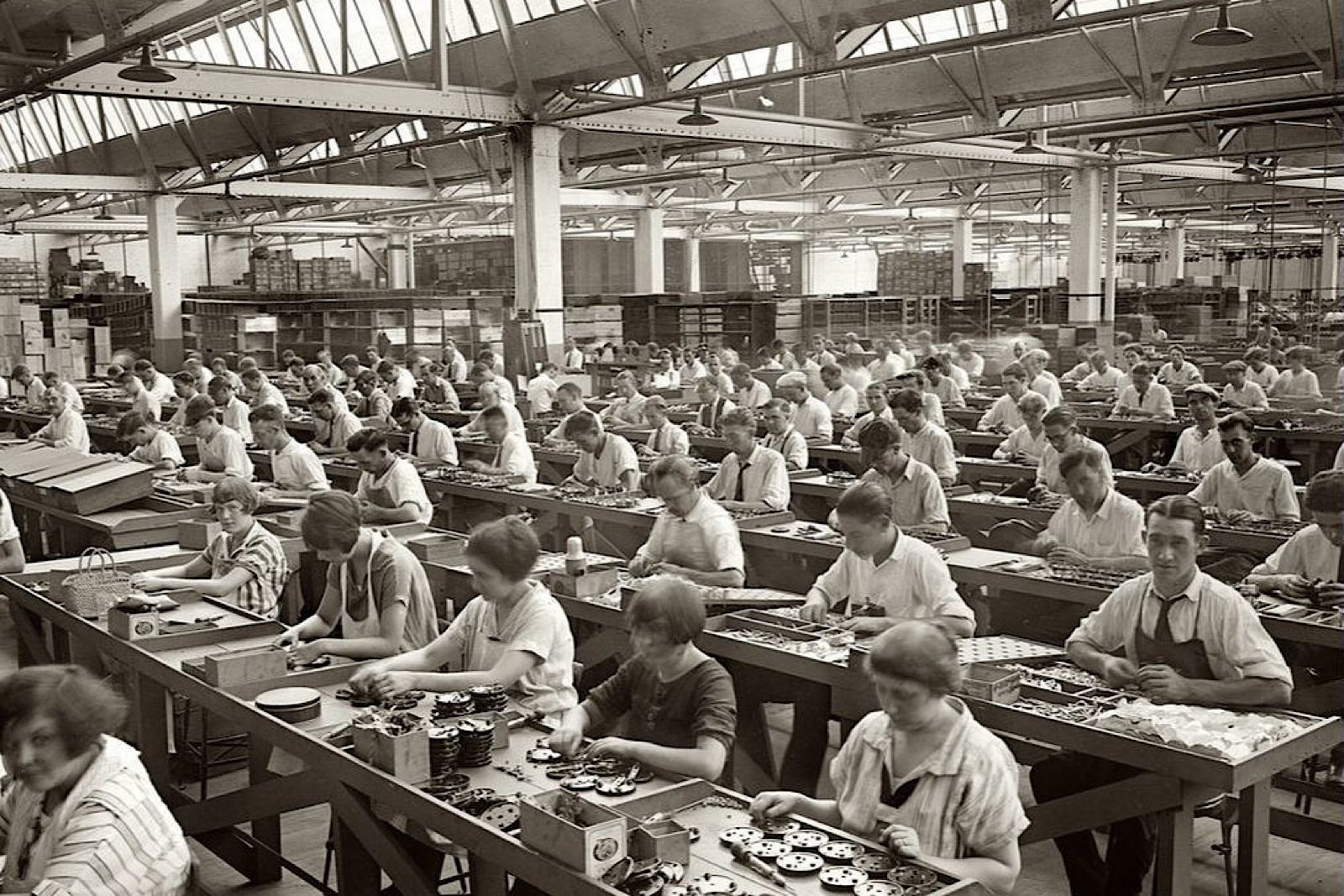
The factory was the change in container. By the 1820s, Manchester had textile mills with hundreds of workers under one roof. By 1840, the household as a place where you did paid productive work was effectively gone in industrializing England. The work hadn’t disappeared. It had migrated. The household survived as a container for family life, but the bundling of work, family, identity, and economic activity it used to do was over.
The transition took roughly sixty years. From the spinning jenny to the death of the putting-out system. Two generations. The people who lived through it mostly didn’t know it was happening at the time. They knew their work was harder to find, their bargaining power was worse, their kids were going to the mills instead of staying home. They didn’t know the container was hollowing. They knew something was gone.
The second time was the clerk. In 1880, the clerk was a craftsman of paper. He kept ledgers by hand. He drafted correspondence in longhand. He maintained files. Becoming a clerk was a respectable apprenticeship that took years to master, and a senior clerk in a big firm was a person of standing.
Then came the typewriter, in commercial use by 1880. Then carbon paper, then the filing cabinet, then the adding machine, then the calculator, then the photocopier, then, eventually, the spreadsheet in 1979. Each of these tools mechanized a piece of what the clerk used to do.
The clerk-as-container didn’t collapse. It bifurcated. The judgment piece, what to write, how to organize a deal, how to manage a senior person’s calendar and politics, became the executive assistant. The codifiable piece, what to type, what to file, what to add up, became the data-entry temp. The wage gap between those two halves grew steadily for a hundred years and is now one of the larger wage gaps in the U.S. economy. The judgment half went up. The codifiable half went down or disappeared into software.
The transition took roughly a hundred years. Slower than the factory because the tools were less concentrated and the work was harder to mechanize. But the pattern was the same: the container persisted in name; the contents migrated; the survivors did different work than the people the container was originally built for.
Hold these two examples next to each other. The household and the clerk. Different industries, different centuries, different technologies. Same pattern. The container is what we keep calling the thing. The work is what changes shape inside it. When we talk about “the death of the household economy” or “the decline of the clerk,” what we usually mean is that the bundle came apart, not that the work stopped.
It’s happening right now
So here we are. Spring 2026. And the same pattern is showing up in three numbers that don’t usually get put next to each other.
The first number is the rate at which the U.S. economy is hiring people. Not unemployment. Hiring. The Bureau of Labor Statistics tracks this in a monthly release called JOLTS, and the most recent print, for February, was 3.1 percent. To give that number a feel: 3.1 percent is the floor of the Great Recession in 2010 and the floor of the COVID lockdowns in April 2020. Two of the worst hiring environments in the last twenty years. We are matching both of them right now, with no recession on the official books and an unemployment rate of 4.3 percent that looks fine on the front page.
The hiring engine has stopped. People aren’t being hired, and people aren’t quitting, because they don’t believe a better job is on the other side. The pipe is closed at both ends. The number of Americans unemployed for six months or more crossed 1.9 million in March, one in four of all unemployed people, and that share has been climbing for three straight years.
The second number is what’s getting built while the hiring stops. Hyperscaler AI capital expenditure, the money the largest tech companies are spending on AI infrastructure, was about $256 billion in 2024. In 2025, it was $443 billion. For 2026, the projections range from $602 billion to $750 billion depending on which analyst you trust. That’s not a feature investment. That’s the kind of money you spend when you’ve decided that the work running on top of the new infrastructure is about to look very different from the work running on the old. Microsoft alone spent $72.4 billion in the first months of fiscal 2026. Meta and Alphabet are running capex-to-revenue ratios above 45 percent. These are existential commitments. Boards approved them. The bet is on the page.
The third number is what’s happening to people while the first two are happening. Mercer publishes a global talent report every two years. The 2026 edition, released in February, has employee thriving collapsed from 66 percent to 44 percent over two years. Twenty-two points. AI job-loss anxiety up from 28 percent to 40 percent. Twelve points. These aren’t small movements. These are signals that something has changed in how working life feels, even for people whose jobs are still nominally intact.
Three numbers: the hiring freeze, the substrate buildout, the mood of the people sitting inside both. Put them together and the pattern is the same one we saw with the household and the clerk. The container is still there, in form. The W-2 is still there. The benefits are still there. The title and the salary and the company picnic, mostly still there. But the work is changing shape inside the container, the engine that used to renew the container by hiring new people into it has frozen, and the people inside know something is gone even when the headline numbers say it isn’t.
The job, as a 150-year-old bundle of income, identity, time, belonging, and benefits, is hollowing. The container is doing less of the work it used to do, the contents are migrating to other forms faster than the container is being remade, and the gap between what a job is supposed to bundle and what it actually bundles is the part most people are feeling but haven’t had words for.
The faster part, compared to the household and the clerk, is what makes this disorienting. The factory took sixty years to hollow the household. The spreadsheet took a hundred years to bifurcate the clerk. The hollowing we’re inside of has been measurably underway for about three years and is accelerating. By the time the historical analogues finished their work, three or four generations had moved through the transition. We’re going to do it in one.
Slow hollowings give institutions time to adapt. Fast hollowings ask a lot of individuals before institutions catch up. This one’s real fast.
Where this goes from here
What I’m not doing in this piece, on purpose, is solving it. I haven’t told you what’s being built underneath the hollowing, what survives it for the people inside, or what posture this is going to take. That’s evolving quickly.
For now, let’s stick to the diagnosis. The job is the container, not the work. The container is hollowing. We’ve seen this shape before, and the part we haven’t seen is how fast.
What do you think? Does that match what you’re seeing in your own work, or in the work of people around you? I’d rather hear from you than guess.
I do rigorous signals intelligence for these pieces. They’ve allowed me to see movements before they happen, things that change a company’s position in a meaningful way that usually doesn’t show up in the planning process. I’ve been doing portfolio and company analyses for investors for a while now, and I’m extending the same tools to founders. You can see what investors see here.
Businesses won’t preserve jobs out of sentiment right? They’ll unbundle work as soon as the economics work.
So the risk may not be mass unemployment, but millions of people forced into fragmented, 'always-on' competition for attention, trust, and short-term work.
I suggest we will need new systems to organise [that] chaos!
Everything you're saying makes a lot of sense to me (per usual). Eagerly awaiting the next few parts.