Playing Above the Line in a Time of Emergence
Why 15 Commitments of Conscious Leadership is vital technology for this moment.
Quick note before we begin: I’ve begun hosting Q&A sessions on Thursdays at 10am MT to go deeper on what I write about here—primarily business, AI, and consciousness. Recent discussions have touched on AI-driven job displacement, reconfiguring companies for a new reality, and signals I’m tracking in my projection models. Link to register is here.
I love people. They light me up. Their charms, their quirks, even their struggles. People are endlessly fascinating to me—a constant emergence of joy. The way someone’s face changes when they realize they’ve been avoiding a conversation they actually need to have. The moment a team stops performing trust and starts feeling it. The look on a founder’s face when they say the thing they’ve been holding back for six months and the world doesn’t end.
But I haven’t always been this way. I haven’t always known how to be in relationship with the kind of presence and clarity I bring to it now. There was a time when being in relationship with people felt heavy. Taxing. Scary. Like something I had to manage rather than something I got to experience. I carried the weight of other people’s emotions without knowing I was doing it. I worked around conflict instead of through it. I had a lot of opinions about who was right and who was wrong, and I spent a lot of energy defending those positions.
It wasn’t terrible. It was just heavy. And it was slow.
Okay, maybe it was terrible.
No single insight or retreat or book changed that orientation for me, though one book played a big role. What changed was a set of practices—things I could actually do, repeatedly, until they became habits. And those habits opened doors I didn’t know were there. They still do.
I’m telling you this because we’re a species that builds AI systems capable of generating entire business plans in seconds, and we still can’t figure out how to tell a cofounder they’re driving us crazy. We can coordinate thousands of people across time zones, but we can’t clear a simple misunderstanding with the person sitting next to us. It’s kind of bizarre when you think about it. And it’s also where the real work is.
We’ve been optimizing old versions of ourselves
The world got complex fast. AI collapsed the time it takes to produce cognitive labor. We’re more connected to more people across more contexts than at any other point in human history. The demands on our relationships—with cofounders, teams, partners, clients, communities—have multiplied. But our capacity to be in those relationships hasn’t kept pace.
That gap’s been mostly manageable for most of our lives. Until recently, you could get by with decent communication skills and a thick skin. You could play the game the way it had always been played: protect your position, hoard information, be the smartest person in the room, win the argument. That logic worked when the game was slower. But now that “decent” skill level creates friction at a rate that compounds against you. And the gap is getting more obvious and more harmful.
There are some thinkers who’ve shaped how I see this, often giving me just enough trust to take small steps beyond where I was. One in particular helped me to reimagine the journey of continuing growth and competence. Frederic Laloux, in Reinventing Organizations, makes the point that higher levels of consciousness aren’t better than lower ones. They simply encompass greater complexity. Ken Wilber calls this “transcend and include”—each new level contains everything that came before it. You don’t lose your ability to be decisive or competitive or strategic. You gain the ability to hold all of that and navigate a much wider field.
Most of us are existing at a level of consciousness that worked beautifully until the complexity outgrew it. And unlike adopting a new tool or optimizing a process, this next breakthrough is relational. It doesn’t happen inside a system. It happens between people.
One technology that was early to market
We don’t usually think of relational skills as technology, but maybe we should. Technology is anything that enables us to do what we do. The organizational chart, invented in 1855, was a technology for coordination. Agile was a technology for adaptive development. Spreadsheets were a technology for financial modeling.
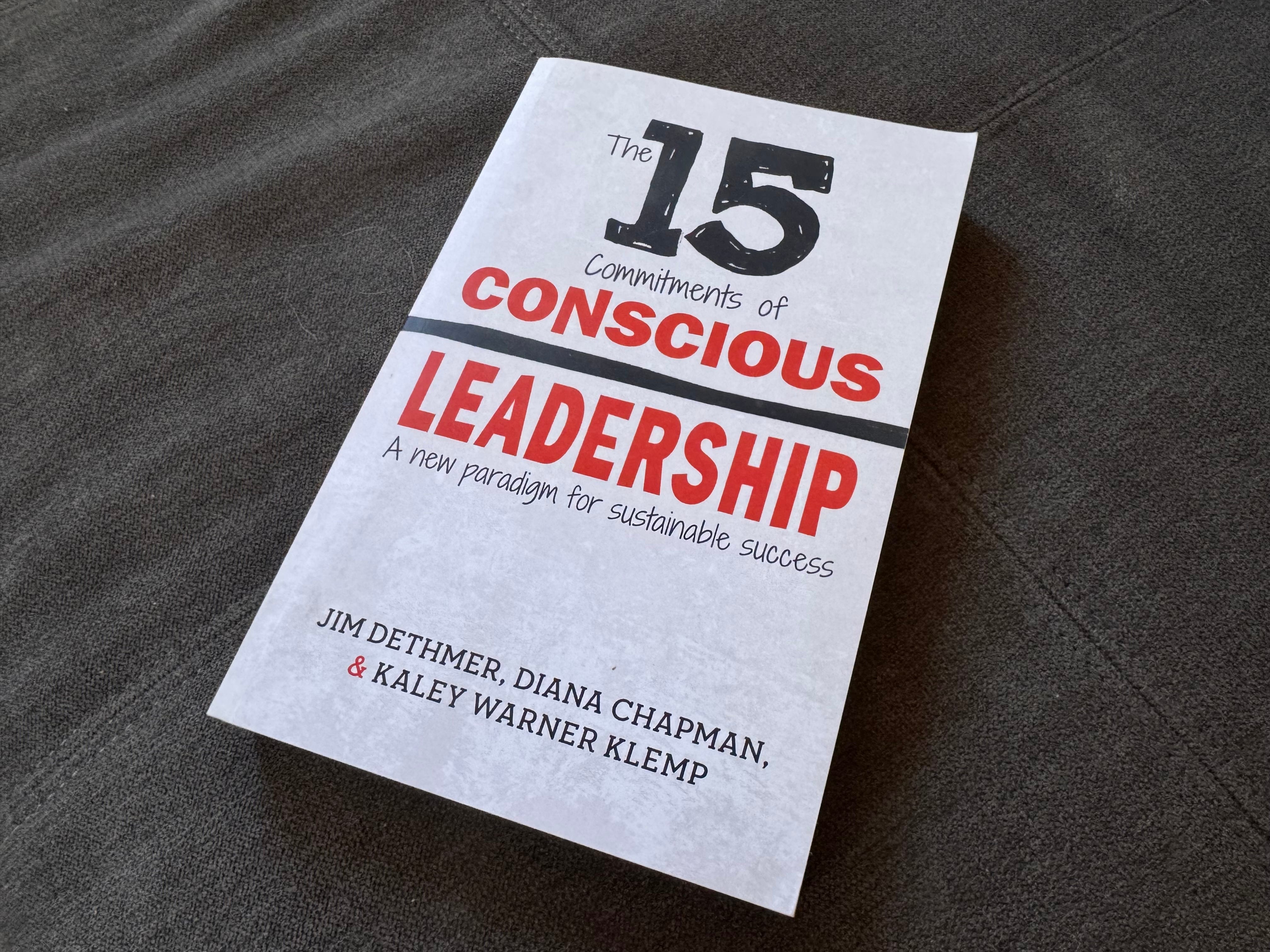
About a decade ago, Jim Dethmer, Diana Chapman, and Kaley Klemp published The 15 Commitments of Conscious Leadership. I think of it as a technology for relationship. And I believe it was early to market.
When it came out, these were very good principles. You could practice them and your life would get better, your leadership would get cleaner, your relationships would deepen. But you could also not practice them and still do okay. The complexity of the world hadn’t yet made them essential.
That’s changing right now.
That old time when you get away with not keeping clean relationships? It wasn’t great. Cleaning up the residue of gossip, lack of candor, submerged feelings, absence of curiosity, lapses of integrity… I’ve watched clients spend half or more of their time dealing with this stuff and somehow managing to call it leadership.
This time isn’t that time. We’re moving faster, and there’s less and less time to spend on fixing your unforced errors. In this era of complexity, clean relationships are nonnegotiable. And I believe the 15 Commitments are a brilliant technology for that.
The org chart enabled coordination for the industrial era. It was a map to help us better navigate the challenges of coordination and cooperation. The 15 Commitments enable relationship for the complexity era. One organized boxes and lines. The other organizes how humans actually show up with each other. And when everything is accelerating—technology, business, geopolitics, the sheer volume of relationships we’re expected to navigate—how we show up with each other is no longer optional development. It’s the foundation.
The cost of friction
Leaders who don’t develop relational capacity aren’t just missing a “soft skill.” They’re moving slower. And in the current environment, slow is expensive.
Every unspoken tension between cofounders. Every avoided conversation that festers into resentment. Every team member who gossips about a colleague instead of talking to them directly. Every meeting where everyone’s committed to being right and nobody’s learning anything. That’s friction. And that friction has a cost measured in time, energy, money, and the emotional weight carried by everyone in the system.
John Gottman’s research on trust might also have been early, and it’s also quite timely. Trust isn’t a feeling. It’s a behavioral pattern. It’s built—and eroded—in small moments, consistently, over time. Not grand gestures. Small, repeated choices about how you show up. The 15 Commitments give you a practice for those moments.
Simon Sinek draws a distinction between finite games and infinite games that I find super useful. A finite game has known players, fixed rules, and an agreed-upon objective. Someone wins, someone loses, and the game ends. An infinite game has known and unknown players, the rules are changeable, and the objective is to keep playing.
Most of what we call “work” has been played as a finite game. I win, you lose. Hoard resources. Play politics. Protect your position. But the actual game—the one involving complex, ongoing relationships with people whose contributions you need and whose trust you can’t fake—is infinite. And when you play a finite game in an infinite context, the mismatch produces predictable symptoms: harder relationships, heavier emotional burdens, more activated nervous systems, and a growing distance between people who actually need to be close.
The drama triangle—hero, villain, victim—can be a good lens. All three roles feel different, but they’re all the same move: closed, defensive, committed to being right. They’re all finite game postures. And they all produce the same outcome: distance.
The alternative isn’t complicated to describe. You don’t need to win the conversation. You need to stay in it. Trust evolves through the play. But you need a practice that keeps you in the game when pressure and complexity want to pull you out.
What the practice actually looks like
The 15 Commitments offer a clear orientation: above the line or below the line. Above the line is open, curious, committed to learning. Below the line is closed, defensive, committed to being right. That’s it. That’s the whole diagnostic. And if you’re honest with yourself, you know exactly which one you’re in at any given moment.
The first seven commitments (responsibility, curiosity, feelings, candor, gossip, integrity, and appreciation) are foundational in my thinking—practice these until they become natural, and you’re living and working better. The remaining eight (genius, play and rest, opposite of my story, approval, enough, allies, win for all, and being the resolution) go deeper. But rather than walk you through all of them, I want to paint a picture.
You know what below the line looks like in a team. You’ve lived it. It’s the cofounders who talk to everyone about each other but never to each other. It’s the meeting where someone raises a concern and it gets explained away rather than explored. It’s the withhold that nobody names—the thing everyone knows but no one says—that calcifies into resentment over weeks and months. It’s the weight you carry when you absorb other people’s emotions because you haven’t developed the practice of feeling your own.
These aren’t character flaws or personality defects—they’re habits. And they’re finite game moves that protect position instead of deepening play.
(A quick word on play: the people winning are usually the ones having the most fun.)
Now contrast that with what it looks like when someone takes radical responsibility instead of assigning blame. When a team has an actual practice (habit or ritual) for clearing withholds. The clearing process gives people a structured way to say the unsaid, without it turning into combat. When I’ve seen teams adopt this, the relief is almost physical. The thing that was draining energy in the background suddenly has somewhere to go. It gets said. It gets heard. And the relationship gets cleaner and faster because of it.
Or what it looks like when appreciation isn’t performative—not the obligatory “great job, team” at the end of a meeting—but generative. Specific. Rooted in actually seeing what someone did and naming it. Gottman’s work shows that trust is built in exactly these moments: small, consistent, genuine. Not heroic gestures. Daily practice.
These aren’t personality traits. They’re practices. The distinction is enormous. Practices can be cultivated. They become habits. And habits become the way you move through the world.
I know this because I’ve lived it. The practices I cultivated through working with these commitments didn’t just make me a better coach. They made me a different kind of person in relationship. Less heavy. More present. More willing to walk toward the thing that scares me. And the people I work with are better, more effective, and more present for it.
Above the line is infinite game posture. Open, curious, committed to learning. The commitments are the specific practices that keep you there when complexity and pressure want to pull you below it.
Simple, not easy
I want to be clear about something: this work is simple. It is not easy.
Real resonance and alignment between people are the result of consistent, principled habits practiced over time. There’s no shortcut. You don’t read the book and transcend. You read the book and then you practice, and practice, and practice, and the practices become the way you relate. That is when things shift.
But when they shift, the advantage is felt before it’s measured. Less emotional weight. A calmer nervous system. The ability to walk toward difficult conversations instead of around them. Better pattern recognition. Better decisions. Cleaner work. Faster work. You’re not pushing harder, but you’re also not dragging the weight of unresolved tension, political maneuvering, and defensive posture behind you.
This is the speed of trust. Don’t think of it as a metaphor or a nice-to-have. Trust is an operational reality. The behaviors that build trust are the behaviors that remove friction, and removing friction is what lets you move at the speed the moment demands.
This is more than just professional effectiveness. It’s a qualitatively different experience of being alive and in relationship. The game itself becomes worth playing. That’s the real gift. Not just better results, though you’ll get those, but a richer, more connected way of being in the world with other people.
Can we be honest about where we are?
I’m not going to end with a framework or an action plan. I want to end with a few honest questions.
Where are you right now—above the line or below it? Not where you’d like to be. Where you actually are.
Is there a conversation you’re avoiding? A withhold you’re carrying? A relationship where you can feel the friction of something unsaid?
What would it take to move toward that instead of around it?
These questions aren’t easy to sit with. But if you sit with them honestly and often, you’ll notice something cool: the awareness itself is the beginning of the practice. You don’t have to be good at it yet. You just have to be willing to notice.
You have to start.
I’ve been doing this work for years now, and it still brings me growth. It’s still sometimes scary. But moving toward the fear—toward the honest conversation, toward the real thing—produces brilliance. Every time. That’s not a sales pitch. It’s just what I’ve seen happen, again and again, in my own life and in the lives of the people I work with.
The 15 Commitments aren’t the only way to get here. But they’re a powerful one. And the time is more right for them now than it’s ever been.
The complexity isn’t going to slow down. But you can expand to meet it.
That’s always been the move.


Nice Joseph.
From a SHシFT perspective, this reads like a call to treat relationships as shared infrastructure. Cool!
Good luck to all of us. We're just wild animals constrained by the decency we beat out of our ancestors and now machines are beating it out of us. Brilliant!
Very good, thanks Joseph!